Introduction: Two Healthcare Careers, One Difficult Choice
Every year, thousands of Kerala students and working professionals search for courses that lead to stable, well-paying healthcare careers. Two options come up again and again: medical coding and hospital administration. Both are positioned as "healthcare careers without MBBS," both attract nurses, arts/commerce graduates, and plus-two holders, and both promise a foot in the door of the booming healthcare sector.
But the comparison ends there. In terms of salary ceiling, career growth, GCC opportunities, job variety, and long-term relevance, hospital administration and medical coding operate in entirely different leagues. This article cuts through the noise to give you an accurate, side-by-side picture — so you can make a decision you will not regret five years from now.
At Treneywann Institute of Hospital Administration, located at Vyttila, Kochi, we have counselled hundreds of Kerala students who faced exactly this dilemma. This guide is based on what we have seen happen to candidates from both paths after joining the healthcare workforce.
₹1.2L+
Sr. Hospital Admin Monthly Salary
512 graduates placed as of 31 July 2026
Treneywann Alumni Placed
16
Departments Covered in Course
What Is Medical Coding? (The Real Picture)
Medical coding is the process of converting diagnoses, treatments, medical procedures, and equipment into universal alphanumeric codes — primarily from ICD-10-CM, CPT, and HCPCS code sets. These codes are used by insurance companies, hospitals, and billing departments to process claims and reimbursements.
Who Does Medical Coding?
Medical coders typically work in:
- Hospital billing departments (as part of the revenue cycle team)
- Third-party medical billing companies
- Remote work-from-home setups (BPO/KPO style)
- Health insurance back-offices
- US healthcare outsourcing firms with offices in Kochi, Thiruvananthapuram, and Kozhikode
What Does a Medical Coder Actually Do?
The day-to-day work of a medical coder is largely data-entry and code-lookup. A coder reads a physician's notes or discharge summaries, identifies the relevant diagnoses and procedures, and assigns the correct codes. There is little to no interaction with patients, hospital management, or clinical staff. The work requires accuracy, attention to detail, and familiarity with coding guidelines — but it does not require management skills, leadership, or strategic thinking.
Important note for Kerala students: Many medical coding job advertisements in Kerala are for US healthcare clients. This means you work night shifts (IST) to align with US office hours. This is a significant lifestyle consideration that course brochures rarely mention.
Medical Coding Salary in Kerala (2026 Reality)
- Fresher / Entry-level coder: ₹12,000 – ₹18,000 per month
- 1–3 years experience: ₹18,000 – ₹28,000 per month
- Senior coder / Auditor (5+ years): ₹28,000 – ₹42,000 per month
- Coding manager / Team lead: ₹40,000 – ₹55,000 per month (rare, high competition)
Salary growth in medical coding is slow and closely tied to certification levels (CPC, CCS) which themselves require additional exam fees and annual renewal fees paid to AAPC or AHIMA.
What Is Hospital Administration? (The Management Career)
Hospital administration is the management and operational backbone of any hospital. A hospital administrator oversees the day-to-day functioning of the institution — coordinating between clinical departments, managing human resources, controlling finances, ensuring regulatory compliance (NABH, JCI), handling patient services, managing vendor contracts, and driving the overall strategic direction of the facility.
Unlike medical coding, hospital administration is a leadership role. Administrators are visible, respected professionals who sit at the intersection of healthcare and business management. They are the people doctors escalate operational problems to. They are the people CEOs and hospital promoters rely on to keep the institution running profitably and compliantly.
What Does a Hospital Administrator Do?
- Oversee OPD, IPD, Emergency, OT, ICU, Pharmacy, Labs, and 12 other departments
- Manage patient admission, discharge, and transfer workflows
- Handle NABH accreditation documentation and internal audits
- Coordinate HR functions — staff recruitment, scheduling, grievance handling
- Monitor hospital revenue, occupancy rates, bed management, and billing efficiency
- Manage vendor contracts, equipment procurement, and supply chain
- Liaise with medical staff, insurance companies, and regulatory authorities
- Drive patient satisfaction initiatives and quality improvement projects
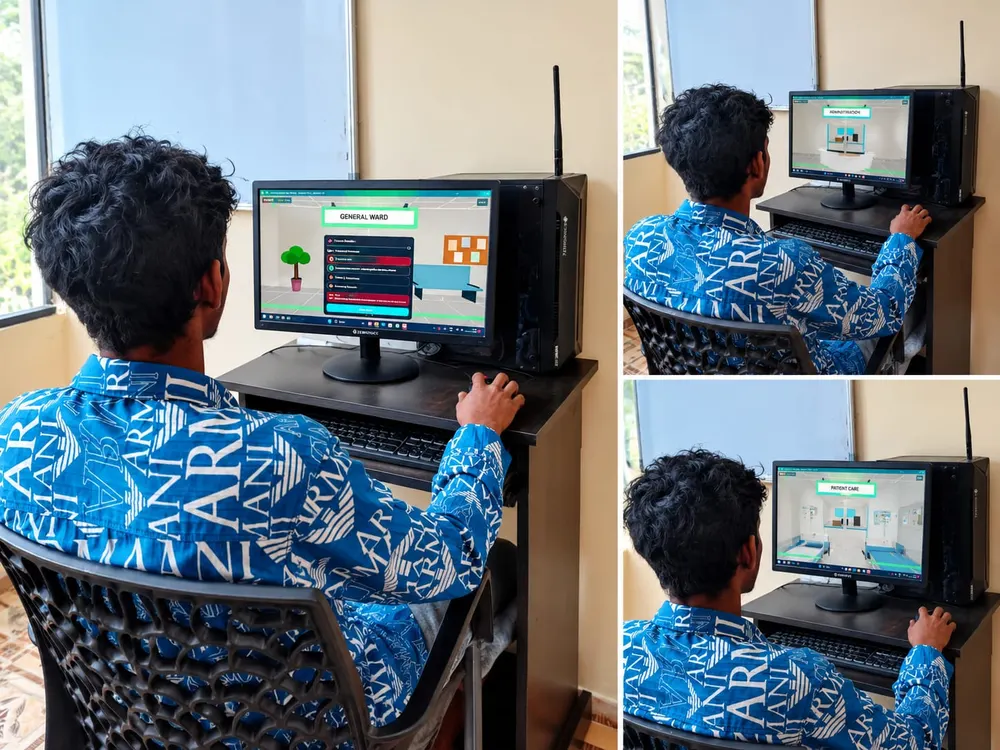
Treneywann Advantage: Our hospital administration curriculum covers all 16 functional departments across 48 NABH-aligned modules. Students get live hands-on training in the Hinall Hospital Management System (HMS) — the only institute in India offering live HMS lab training. This is the same software used by leading Kerala hospitals, giving graduates a practical edge from day one.
Hospital Administration Salary in Kerala (2026)
- Junior Administrator / Admin Executive (fresher): ₹18,000 – ₹25,000 per month
- Department Coordinator (1–2 years): ₹28,000 – ₹45,000 per month
- Operations Manager (3–5 years): ₹50,000 – ₹80,000 per month
- Hospital Director / GM (7+ years): ₹80,000 – ₹1,20,000+ per month
- CEO of multispecialty hospital: ₹1,50,000 – ₹3,00,000+ per month
The salary ceiling in hospital administration is dramatically higher, and the career ladder is longer and more varied. Learn more on our dedicated page: Hospital Administration Salary in Kerala.
Medical Coding vs Hospital Administration: Complete Comparison Table
The table below compares both career paths across 10 key criteria. Use this as a quick reference when making your decision.
| Criteria |
Medical Coding |
Hospital Administration |
| Fresher Salary (Kerala) |
₹12,000 – ₹18,000 / month |
₹18,000 – ₹25,000 / month |
| Salary Ceiling |
₹40,000 – ₹55,000 (senior/manager) |
₹1,20,000 – ₹3,00,000+ (director/CEO level) |
| GCC / Abroad Scope |
Limited; AED 3,000–6,000/month in back-office roles |
High demand; AED 5,000–18,000/month in management roles |
| Career Growth Path |
Coder → Senior Coder → Auditor → Coding Manager (narrow) |
Executive → Coordinator → Manager → Director → CEO (broad) |
| Work Environment |
Desk/remote; night shifts for US clients; low interaction |
Hospital floor; leadership role; high visibility |
| Skill Requirements |
Code memorisation, accuracy, ICD/CPT knowledge |
Leadership, communication, operations, finance, HR, quality |
| Job Variety |
Billing, coding, auditing (same type of work) |
OPD admin, IPD, HR, finance, quality, NABH, supply chain, etc. |
| Course Duration |
3–6 months (coding-specific) |
6 months – 1 year (diploma / PG diploma) |
| Ongoing Cost |
Annual certification renewal fees (AAPC/AHIMA) |
No recurring certification fees after course |
| Demand Trend |
Partially at risk from AI-assisted auto-coding tools |
Growing with Kerala's expanding hospital sector; AI-resistant management role |
Career Growth: Where Will You Be in 5 Years?
Career progression is one of the most important — and most overlooked — factors when choosing a healthcare course in Kerala. Let us look at what 5 years in each field actually looks like.
5-Year Trajectory: Medical Coder
A medical coder in Kerala typically spends the first 1–2 years mastering ICD-10 and CPT codes, working in a BPO or hospital billing department. By year 3–4, those who perform well may be promoted to senior coder or team lead. By year 5, a top-performing coder might be a coding auditor or coding supervisor — still doing largely the same type of work, with a salary in the ₹30,000–₹45,000 range. Further advancement into management requires additional credentials (CPC, CCS) plus several more years of experience. The path is narrow and competitive.
5-Year Trajectory: Hospital Administrator
A hospital administration graduate from Treneywann typically joins as an Admin Executive or Department Coordinator in a hospital like Aster Medcity, KIMS, Rajagiri, or VPS Lakeshore. Within 18–24 months, with strong performance, they often move into supervisory roles. By year 3–4, they may be managing a department or overseeing OPD/IPD operations. By year 5, many of our alumni are at Operations Manager or Assistant Administrator level, earning ₹50,000–₹70,000 in Kerala — or AED 8,000–12,000 in GCC. The ceiling is much higher, and lateral movement across departments keeps the career intellectually engaging.
Verdict: Hospital administration offers a broader, faster, and higher-paying career trajectory than medical coding. The management track leads to real leadership positions — hospital director, CEO, healthcare consultant — that are simply not available on the medical coding path.
GCC Opportunities: Hospital Administration Wins Decisively
For Kerala candidates, overseas employment — particularly in Gulf Cooperation Council (GCC) countries — is a major consideration. Both UAE and Saudi Arabia have seen massive investment in private and government hospital infrastructure, creating strong demand for trained healthcare management professionals.
Hospital Administration in GCC
Hospitals across UAE, Saudi Arabia, Qatar, Bahrain, Kuwait, and Oman actively recruit Indian hospital administrators for roles in operations, patient services, HR, quality, and administration. JCI-accredited and CBAHI-accredited hospitals require trained professionals who understand international quality standards. Roles available include:
- Hospital Administrator / Operations Manager
- Patient Relations Manager
- Quality and NABH/JCI Coordinator
- HR Executive — Healthcare
- Medical Records Officer
- Supply Chain and Procurement Officer
Salaries for these roles typically range from AED 5,000 to AED 18,000 per month (approximately ₹1,13,000 – ₹4,07,000), tax-free, with accommodation and transport allowances often included.
Treneywann's embassy attestable certificates make our graduates' qualifications internationally recognised, giving them a verified advantage when applying for GCC positions.
Medical Coding in GCC
GCC hospitals do have billing and coding departments, but these roles are far fewer in number, lower in pay (AED 3,000–6,000), and often filled by candidates with several years of experience in US healthcare coding — a specialisation with a steep learning curve. For freshers from Kerala, GCC medical coding opportunities are significantly more competitive and less rewarding than hospital administration roles.
Explore more about international career prospects on our Hospital Administration Jobs in Kerala page.
Skill Requirements: Management vs Data Entry
Understanding what each career actually demands of you day-to-day is essential before committing to a course and career path.
Skills You Need for Medical Coding
- Memorisation of ICD-10-CM, CPT, and HCPCS code sets
- Ability to read and interpret physician notes and discharge summaries
- Accuracy and consistency in data entry
- Knowledge of medical terminology (anatomy, pathology, pharmacology)
- Familiarity with insurance and reimbursement rules
- Certification maintenance (CPC requires 36 CEUs every 2 years)
These are legitimate technical skills — but they are narrow. They do not prepare you to manage people, run departments, negotiate with vendors, handle compliance, or lead strategy meetings. As AI-assisted coding tools become more accurate, the routine code-lookup component of this job is increasingly automated.
Skills You Develop Through Hospital Administration
- Hospital operations management (all 16 departments)
- Leadership and team management
- Healthcare finance, budgeting, and revenue cycle understanding
- NABH quality standards and accreditation processes
- Human resources management in a healthcare setting
- Patient services and grievance redressal
- Supply chain and procurement management
- Hospital Management System (HMS) — live Hinall software at Treneywann
- Communication, negotiation, and conflict resolution
- Medical records and legal compliance
Hospital administration builds a portfolio of transferable management skills that remain valuable regardless of how technology evolves. A skilled hospital administrator is not a data processor — they are a decision-maker and leader who cannot be replaced by software.
Who Should Choose Hospital Administration?
Hospital administration is the right career path if any of the following describe you:
- You are a nurse (GNM or BSc Nursing) looking to transition from bedside work to management
- You are a BCom, BBA, or BA graduate who wants a career in the healthcare sector
- You have completed plus-two and want a professional management career without a medical degree
- You are interested in working in GCC countries in a well-paid management role
- You want a career with leadership potential and a high salary ceiling
- You prefer working in a dynamic environment with people, rather than a quiet desk with screens
- You want a career that remains relevant and valuable regardless of AI developments
Note for Nurses: A hospital administration diploma is one of the best investments a working nurse can make. Clinical knowledge combined with management training positions you as a uniquely qualified candidate — hospitals prefer hiring nurse-administrators over pure management graduates for department head and patient-services roles. Treneywann has placed several nursing professionals in senior administration roles at Aster Medcity and Amrita Hospital, Kochi.
Hospital Administration Course at Treneywann, Kochi
If you have decided that hospital administration is the right path, your next step is choosing the right institute. Treneywann Institute of Hospital Administration is Kerala's leading hospital administration training institute, located at the 2nd Floor, Creative Tower, Near Kaniyampuzha Road, Eroor South, Vyttila, Kochi — one of the most accessible locations in the city, minutes from Vyttila Mobility Hub.
What Makes Treneywann Different
- Live Hinall HMS Lab: The only institute in India offering live training on Hinall Hospital Management System — the actual software used by leading Kerala hospitals.
- 48 NABH-Aligned Modules: Curriculum built around India's national accreditation standards, covering all 16 hospital departments in depth.
- 5 certifications, including embassy-attestable credentials (TTMSTRCT Diploma and UGC-approved university certificate),: Internationally verifiable credentials that are accepted for GCC employment visa processing.
- 100% Placement Assurance: 512 graduates placed as of 31 July 2026 at Aster Medcity, Rajagiri Hospital, VPS Lakeshore, Amrita Hospital, KIMS, and more.
- Expert Faculty: Practising hospital administrators and healthcare management professionals — not just academics.
- Small Batch Sizes: Personalised attention, not 100-student lecture halls.
- Rated 4.9★ by students and alumni.
Course Options and Fees
- 6 Months Hospital Administration Course: ₹42,000 (all-inclusive, no hidden charges) | EMI available from ₹7,000 initial payment
- 1-Year PG Diploma in Hospital Administration: ₹64,000 (all-inclusive) | EMI available
Next Batch Starts: 9 November 2026. Seats are limited. Call +91 90379 86219 to reserve your place or walk in for a free counselling session.
For detailed course information, visit our main page: Hospital Administration Course in Kerala.
Frequently Asked Questions
What is the difference between medical coding and hospital administration in Kerala?
Medical coding involves assigning standardized alphanumeric codes (ICD-10, CPT, HCPCS) to diagnoses and procedures for billing and insurance purposes — it is primarily a data-entry and compliance role performed at a desk or remotely. Hospital administration, by contrast, is a management discipline covering operations, HR, finance, patient services, NABH quality, supply chain, and strategic planning across all 16 departments of a hospital. In Kerala, hospital administrators work directly with department heads, doctors, and management, making it a leadership career rather than a back-office role.
Which pays more in Kerala — medical coding or hospital administration?
Hospital administration offers a higher salary ceiling than medical coding in Kerala. Entry-level medical coders earn approximately ₹12,000–₹18,000 per month, with senior coders reaching ₹25,000–₹35,000 after several years. Hospital administrators start at ₹18,000–₹25,000 and can reach ₹60,000–₹1,20,000 or more at senior and director level. In GCC countries, hospital administrators command AED 5,000–18,000 per month, significantly above GCC-based coding roles that typically offer AED 3,000–6,000.
Is hospital administration better than medical coding for long-term career growth in Kerala?
Yes. Medical coding follows a relatively narrow vertical — junior coder → senior coder → coding auditor → coding manager — with limited crossover into hospital leadership. Hospital administration offers a broad growth path: administrator → department head → operations manager → hospital director → CEO/COO. It also opens doors in healthcare consulting, NABH accreditation, project management, and international hospital management roles in GCC countries. Kerala's expanding private hospital sector gives hospital administrators far more and better career options.
Can nurses or plus-two holders from Kerala switch to hospital administration?
Yes. Hospital administration courses in Kerala welcome nurses, BSc graduates, BCom/BBA holders, and even plus-two (12th pass) candidates. A nursing background is particularly valuable because clinical knowledge combined with management training is highly sought by hospitals. At Treneywann Institute of Hospital Administration in Kochi, candidates from nursing, arts, commerce, and science backgrounds are all admitted. The 6 Months Hospital Administration Course (₹42,000; for healthcare professionals, doctors, nurses and paramedical holders) and 1-Year PG Diploma (₹64,000) programmes both include live HMS lab training and certifications, including embassy-attestable credentials (TTMSTRCT Diploma and UGC-approved university certificate), making them ideal for career-changers.
What is the scope of hospital administration in GCC countries for Kerala candidates?
Kerala candidates with hospital administration diplomas are in high demand across UAE, Saudi Arabia, Qatar, Bahrain, Kuwait, and Oman. GCC hospitals — many JCI and CBAHI accredited — require trained administrators for operations, patient services, billing, HR, and quality departments. Treneywann's Embassy attestable certificates make the credential internationally recognised, and the placement network includes hospitals across the GCC. Salaries typically range from AED 5,000 to AED 18,000 depending on role and emirate, far exceeding what is available for comparable medical coding positions.
What is the course fee for hospital administration in Kerala at Treneywann?
Treneywann Institute of Hospital Administration in Kochi offers two programmes: a 6 Months Hospital Administration Course at ₹42,000 (all-inclusive) and a 1-Year PG Diploma in Hospital Administration at ₹64,000. Both fees are fully inclusive with no hidden charges. EMI is available starting at ₹7,000 initial payment followed by easy monthly instalments. Both programmes include 5 certifications, including embassy-attestable credentials (TTMSTRCT Diploma and UGC-approved university certificate),, live Hinall HMS lab training, 48 NABH-aligned modules, and a 100% placement assurance, with 512 graduates placed as of 31 July 2026 at hospitals like Aster Medcity, Amrita, KIMS, Rajagiri, and VPS Lakeshore.
Ready to Choose Hospital Administration? Join Treneywann's August Batch
Next Batch starts 9 November 2026. Limited seats available. Get free career counselling, tour the HMS lab, and meet our placement team — no commitment required.
Office 49/A, Creative Tower, 2nd Floor, Near Kaniyampuzha Road, Eroor South, Vyttila, Ernakulam, Kerala 682306 | 4.9★ Rated | EMI Available
.png)