
Best Short-Term Courses After Plus Two Kerala 2026 Compared | Treneywann Group Kerala

Best Short-Term Courses After Plus Two in Kerala 2026 — 8 Options Compared on Duration, Fees, Job Role and Salary

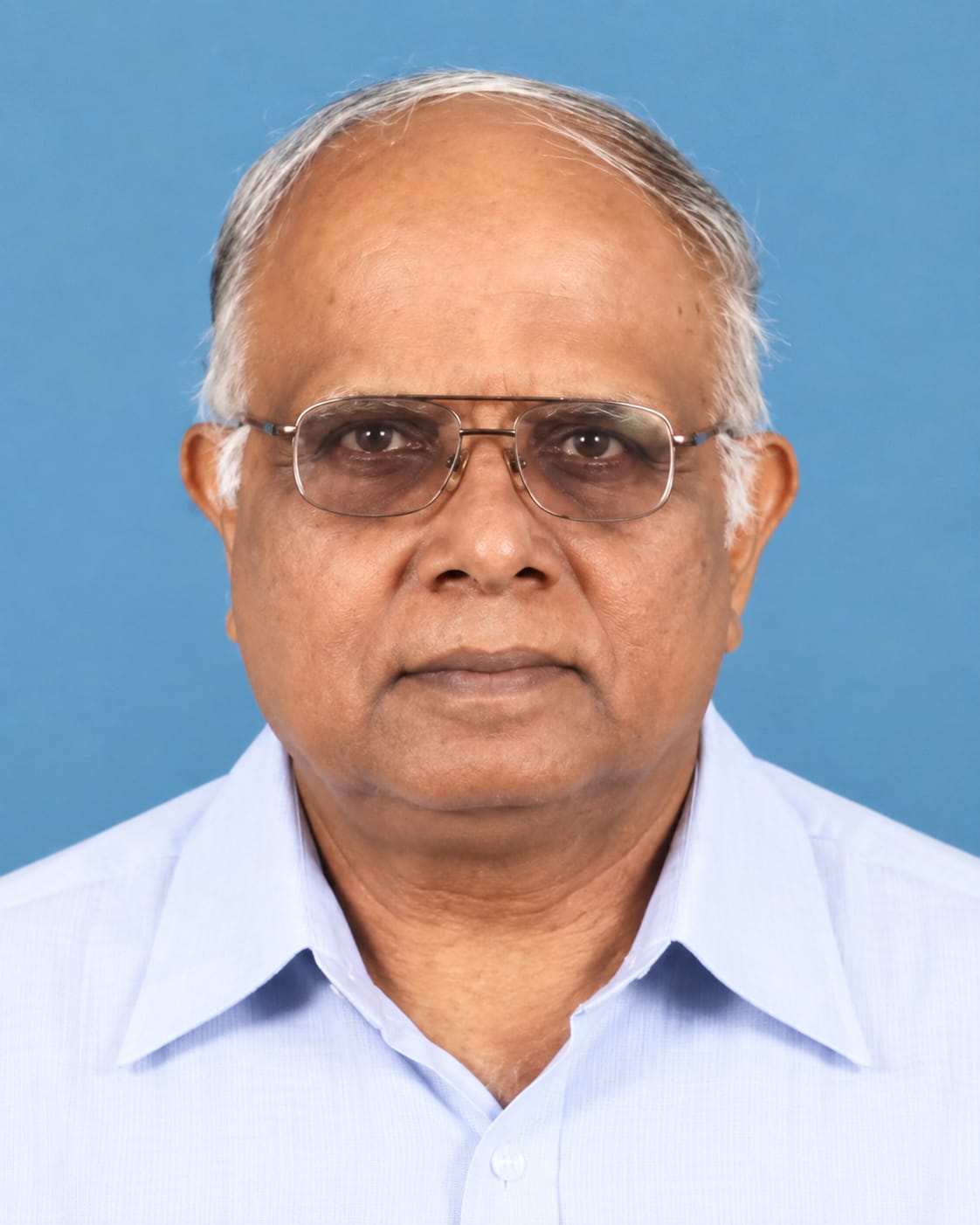
A neutral comparison of the short employment-focused courses a Kerala Plus Two student actually chooses between — hospital administration, medical coding, paramedical, nursing, logistics, accounting, digital marketing and data entry. Treneywann Management Studies, a hospital administration training institute in Vyttila, Kochi. Reviewed by HOD B.V. Kumar (MHA, MBA, MA, PGDPR, PGDJ — 35+ years across India and the GCC).

Quick answer: which short-term course should you take after Plus Two in Kerala?

There is no single best short-term course, and any page that names one in its headline is selling rather than advising. The right choice turns on four things: whether you want clinical or non-clinical work, how soon you need a salary, whether you have a Science background, and whether you want a fixed job or a career ladder. In short:

  • Want patient care? Nursing (GNM/ANM) or a clinical paramedical diploma — genuinely good routes, but 1–3 years, not short.
  • Want a hospital job without clinical work? Hospital administration — 6 months to 1 year, any Plus Two stream, ₹18,000–₹25,000/month at entry in Kerala.
  • Prefer documents to people? Medical coding — 3–6 months, precision work, often shifts aligned to overseas clients.
  • Commerce background, tight budget? Accounting with Tally and GST — the cheapest structured route, 2–4 months.
  • Near Kochi port or airport? Logistics and supply chain — 3–6 months, steady local demand.
  • Willing to build a portfolio? Digital marketing — 3–6 months, but the certificate alone is worth very little.
  • Need income immediately? Data entry or BPO — fastest, and honestly the lowest ceiling of the eight.

Kerala treats the degree as the default and everything else as a fallback. For many students that default is right. For many others it is not — not because degrees are bad, but because a three-year BA or BCom taken without conviction, followed by two years of hunting for work that never required it, is an expensive way to arrive somewhere a six-month course would have reached in year one.

This page does not tell you which course to take. It sets out what each of the main short options actually involves, what it costs, what job it ends in, what that job pays in Kerala, and who it suits — so that you can decide. Where hospital administration is the honest answer we say so, and where it is not, we say that too. Treneywann teaches hospital administration; read everything below with that in mind, and hold us to the same standard we apply to the alternatives.

Jump to: how to choose · the comparison table · cost per month of study · who should not take hospital administration · if Plus Two is not cleared · FAQs

What Counts as a "Short-Term Course" in Kerala — and What Only Pretends To

The phrase is used loosely in Kerala advertising, which is the first problem a student runs into. A course marketed as short can mean anything from a three-week software module to a two-year clinical diploma. Before comparing anything, separate the field into three honest groups.

1. Skill courses (1–4 months)

Tally and GST, basic computing, data entry, spoken English, a single design or marketing tool. These teach one usable skill. They are cheap and fast and they add to a CV, but on their own they rarely define a career. Best used as a supplement, or as a stopgap while you study something larger.

2. Job-role courses (3–12 months)

Hospital administration, medical coding, logistics and supply chain, a full digital marketing programme. These are built around a named designation that employers actually advertise for. This is the group most people mean by a short-term course, and where the real decision usually sits.

3. Regulated qualifications (1–3 years)

GNM and ANM nursing, DMLT, radiology, dialysis and OT technology. Frequently listed alongside short courses in advertisements, and they are not short. They are also the only routes on this page that let you work clinically, which is exactly why they take longer.

Two practical consequences follow. First, if an advertisement calls a two-year DMLT a short-term course, it is not lying about the qualification but it is misleading about the commitment — plan for the real duration. Second, if a course sits in group one but is priced like group two, ask what job title it ends in. That single question resolves most of the confusion in this market.

Everything in the comparison table below is labelled with its true duration, so a three-month skill course and a three-year clinical qualification are never presented as the same kind of decision.

How to Choose — Seven Questions to Answer Before You Pay Any Fee

Answer these honestly and the shortlist usually reduces itself to two options. Answer them after enrolling and you will have paid to discover them.

1. Does it end in a named job role?

Ask for the exact designation you will apply for on completion — front office executive, billing executive, medical coder, accounts assistant, logistics coordinator. If the answer is a vague field name such as "healthcare" or "management", the course has no job attached to it. Every option in the table below has a real designation; that is why it is in the table.

2. Is there an actual placement route, and is it written?

"Placement support" can mean a WhatsApp group of forwarded job posts. Ask three things: which employers took last year's batch, how many of that batch are working now, and whether the placement commitment is written into the admission document. A verbal promise is not a commitment. This single question separates serious institutes from the rest, in every category on this page.

3. Does it require maths, Science or Biology?

This closes doors faster than anything else. Nursing and most clinical paramedical diplomas expect Science with Biology. Data and analytics routes expect comfort with mathematics. Hospital administration, accounting, logistics, digital marketing and medical coding do not — they are open to Commerce and Humanities students, which matters in Kerala where those two streams carry the majority of Plus Two candidates.

4. Can you do it alongside something else?

A course that runs in the evening or at weekends can be combined with a distance degree, a pending Plus Two supplementary attempt, or a part-time job. A full-day clinical course cannot. If your plan involves finishing anything else at the same time, ask about batch timings before you pay, not after.

5. What does it cost per month of study — and what is excluded?

A total fee tells you very little on its own. Divide it by the number of months, then ask what the figure leaves out. Certification exam fees, study material, software access, internship charges and placement registration are commonly quoted separately and can add substantially. An all-inclusive fee and an apparently lower fee with four add-ons are not comparable numbers.

6. Are the employers in Kerala, or somewhere you would have to move to?

A skill whose employers are all in Bengaluru or Hyderabad is a relocation decision, not just a course decision — and for many families that changes the answer completely. Hospitals, audit offices, logistics firms and coding companies all recruit within Kerala. Some technology roles do not, in volume. Ask where last year's batch is physically working.

7. Where does this role sit after five years?

Starting salary is the number everyone compares and the least important one. Some short courses lead into a ladder — executive, senior executive, supervisor, manager. Others lead to a job that is still recognisably the same job at year ten. Neither is wrong, but know which one you are buying. Ask what the person who joined five years ago is doing now.

Keep your seven answers in mind while reading the table. No option wins every column — each is a bundle of trade-offs, and the aim is not to find the highest-rated course but the one whose trade-offs match your answers.

The Main Comparison — 8 Short-Term Routes After Plus Two in Kerala

Fee ranges and salaries below are indicative Kerala ranges gathered across each category, not quotes from any named institute, and they move with location, employer size and the individual candidate. Treat them as a planning guide and verify current figures locally. Only the Treneywann row states an exact fee, because it is our own published fee.

The list is not ranked. It runs from the shortest genuine commitment to the longest.

Short-term study routes after Plus Two in Kerala — duration, indicative fee range, the actual job, realistic Kerala starting salary and who it suits.
Course Typical duration Indicative fee range (Kerala) What the job actually is Realistic Kerala starting salary Who it suits
Data entry / BPO 1–3 months ₹3,000–₹12,000 Keying records, voice or chat support, back-office processing against a fixed target ₹9,000–₹14,000 Anyone who needs income immediately. Honestly the lowest ceiling here — treat it as a bridge, not a destination
Accounting / Tally / GST 2–4 months ₹6,000–₹20,000 Bookkeeping, GST returns, invoicing and accounts assistance in small firms and audit offices ₹12,000–₹18,000 Commerce students, and anyone wanting the cheapest structured route into office work
Digital marketing 3–6 months ₹15,000–₹60,000 Social media, paid ads, SEO and content in an agency, an in-house team, or freelance Highly variable — commonly ₹12,000–₹22,000, with a wide spread either side Self-starters who will build and keep building a public portfolio. The certificate alone counts for little
Logistics / supply chain 3–6 months ₹15,000–₹50,000 Warehouse and inventory coordination, freight documentation, dispatch and last-mile tracking ₹14,000–₹20,000 Students near Kochi port, the airport or an industrial belt; suits organised, systems-minded people
Medical coding 3–6 months ₹20,000–₹60,000 (certification exam fee usually extra) Reading clinical notes and assigning ICD/CPT codes for insurance claims, usually in a coding company ₹15,000–₹22,000 Detail-focused students who prefer documents to people and can accept shifts aligned to overseas clients
Hospital administration 6 months or 1 year Category range ₹25,000–₹70,000. Treneywann: ₹37,000 (6 months) or ₹57,000 (1 year), all-inclusive Non-clinical hospital desk work — front office, admissions and discharge, billing, TPA and insurance, medical records, NABH quality, HMS software ₹18,000–₹25,000 Any Plus Two stream, no NEET. Suits students who want a hospital career without clinical duties, and who are comfortable with people and paperwork together
Paramedical diplomas (DMLT, radiology, dialysis, OT tech) 1–2 years (not truly short) ₹40,000–₹1,50,000 Hands-on laboratory, imaging, dialysis or operation-theatre technical work supporting clinical care ₹12,000–₹20,000 Science students who want to be inside clinical work and can commit one to two years
Nursing routes (GNM, ANM) 2–3 years (clinical, not short) ₹1,00,000–₹3,00,000 Direct patient care on wards and in community health, with shift and night duty ₹15,000–₹25,000, with strong overseas mobility later Science-with-Biology students committed to bedside care. A recognised profession, and the longest commitment on this list

Notes on the figures: fee ranges describe the category across Kerala and deliberately name no competing institute. Salary bands are for freshers in Kerala in 2026 and exclude the GCC, where several of these roles pay considerably more. Nursing and paramedical rows are included because students genuinely weigh them against short courses, even though both are longer regulated qualifications.

For a deeper look at the two clinical rows, see our comparison of paramedical courses in Kerala, and for the nursing decision specifically, hospital administration compared with nursing. The coding row is examined in detail in medical coding versus hospital administration in Kerala.

Reading the Table — What Each Option Is Really Like

A table flattens things unfairly. Here is the fuller picture of each row, including the part the advertisements leave out.

Data entry and BPO

The fastest route to any paycheck in Kerala, and we will not pretend otherwise — a month of training and you can be working. It also has the weakest trajectory of the eight: the work is measured on volume and accuracy, progression usually means leading a team doing the same task, and the entry-level portion is exactly what automation is steadily absorbing. It has a legitimate use as income while you complete Plus Two supplementary papers, a degree or another course. As a ten-year plan it is the weakest option here.

Accounting, Tally and GST

Excellent value and genuinely useful. Two to four months, the lowest fee of any structured course, and every small business and audit office in Kerala needs someone who can raise invoices and file returns. For a Commerce student it builds directly on Plus Two. The honest limitation is the ceiling: an accounts assistant who does not add a degree, a CA articleship or a specialist qualification tends to remain an accounts assistant, and the pay curve flattens after a few years. Many students use it well as a first job that funds a parallel BCom.

Digital marketing

The widest spread of outcomes on this page. Students who treat the course as a starting point — running real campaigns, building a public portfolio, learning analytics properly — do very well, and the freelance and remote options are real. Students who collect the certificate and stop tend to struggle, because employers hire on evidence of results rather than completion. It is the least predictable option here, which is not the same as the worst. If you are self-directed it may be the best fit on this list; if you need structure and an assured placement route, it is a difficult choice.

Logistics and supply chain

Quietly one of the better short options in Kerala, and under-discussed. Kochi's port, airport and warehousing cluster generate steady demand for documentation, dispatch and inventory coordination, and e-commerce has widened it across the state. There is a real ladder — coordinator to supervisor to operations manager — and Gulf demand for experienced logistics staff is substantial. The trade-offs are geography, since jobs cluster around ports, airports and industrial belts, and hours, since dispatch operations do not run nine to five.

Medical coding

A real profession with real demand, deserving neither the hype nor the dismissal it usually receives in Kerala. The work is solitary and exacting: reading clinical documentation and assigning the correct ICD and CPT codes, assessed on accuracy percentages. It suits people who genuinely enjoy detail and rules. Check two things before enrolling. The certification examination fee is usually charged separately from the course fee, so the advertised price is often not the full price. And most Kerala coding employers serve overseas clients, so shift timings frequently run into the night. If you would rather work with documents than with people, this may fit you better than hospital administration.

Hospital administration

The non-clinical door into a hospital. You work at a desk inside the hospital — admissions, front office, billing, TPA and insurance claims, medical records, NABH quality documentation — coordinating between patients, doctors and departments all day on hospital management software. It is open to Plus Two of any stream with no NEET and no entrance examination, which makes it one of the widest-open options for Commerce and Humanities students. Its strengths and its limits are set out in the two sections below.

Paramedical diplomas — DMLT, radiology, dialysis, OT technology

Proper clinical qualifications, and they should be respected as such. A lab technologist, radiographer or dialysis technician does skilled work a hospital cannot function without. Two honest caveats when comparing them with short courses: the duration is one to two years rather than months, and most programmes expect Science with Biology at Plus Two. Entry salaries in Kerala are often modest relative to the time invested, though they improve with specialisation and with overseas movement. If clinical work is what you want, this is a far better answer than any three-month alternative.

Nursing — GNM and ANM

Nursing is not a short course and it would be misleading to list it as one, but Kerala students weigh it against short courses constantly, so it belongs in the comparison. GNM runs about three years and ANM about two, both fully clinical with shift and night duty, and both normally requiring Science with Biology. What nursing offers that nothing else here matches is international mobility: a Kerala-trained nurse has genuine routes to the Gulf, the UK, Ireland and beyond, and long-term earnings can be well above everything else listed. The cost is time, physical demand and the emotional weight of bedside care. If that is what you want, take the longer road — do not substitute a shorter course and expect to feel satisfied.

Cost Per Month of Study — The Number Almost Nobody Compares

Students compare total fees, which is the wrong comparison, because a total fee mixes three different things: how long the course runs, what it includes, and what it leads to. Two questions fix this.

Question one: what does it cost per month of study? Divide the total fee by the number of months. A ₹20,000 course over two months costs ₹10,000 a month. A ₹37,000 course over six months costs about ₹6,200 a month. The apparently cheaper course is more expensive per month of teaching you receive — which may still be the right choice, but you should know it.

Question two: how many months of your first salary does the course cost? This is the number that actually matters. A course costing ₹37,000 that leads to ₹20,000 a month costs under two months of that salary. A course costing ₹15,000 that leads to ₹10,000 a month costs one and a half months of a much smaller salary — and leaves you at a lower starting point for every year that follows.

Then check what the fee excludes. Across Kerala the commonly separated items are certification and examination fees, study material, software or lab access, internship charges, and placement registration. A fee that looks lower than a competitor's is often lower precisely because three of those five sit outside it. Ask for the number you will actually pay from admission to certificate, in writing.

Ask about the payment structure too. A course you can pay monthly is a genuinely different financial proposition from one demanding the full amount at admission, particularly for a family funding this out of ordinary income. At Treneywann the 6-month programme is ₹37,000 all-inclusive₹7,000 at admission plus 5 monthly instalments of ₹6,000 — and the 1-year programme is ₹57,000 all-inclusive₹5,000 at admission plus 10 monthly instalments of ₹5,200. There is no lump-sum route, and nothing is charged separately for the certifications or the software lab. Whichever institute you choose, insist on the same clarity; the full breakdown of ours is on the hospital administration course fees page.

Finally, sense-check the salary side rather than accepting a brochure figure. Our Kerala hospital administration salary breakdown sets out what each role actually pays by year, and you should ask every institute you visit for the equivalent — role by role, not a single impressive number.

Where Hospital Administration Genuinely Fits — Its Real Strengths

We teach this course, so treat what follows as an argument to be tested rather than a verdict. These are the four things hospital administration is genuinely good at, and each applies only to certain students.

It is the non-clinical door into healthcare. Many students want to work in a hospital without wanting to nurse, inject, scan or handle specimens. Until they find administration they usually assume the only routes in are clinical, and either force themselves towards nursing or abandon healthcare entirely. Front office, admissions, billing, TPA processing, medical records and quality are full careers inside the same building, done at a desk on ordinary hours.

No NEET, no entrance examination, any stream. Kerala produces a very large number of Plus Two students who did not take Science, or who took Science and did not clear NEET. For that group healthcare appears closed. It is not — the administrative side of every hospital accepts Commerce and Humanities backgrounds without qualification, and Commerce students in particular start ahead in billing, TPA and insurance work, because the logic of invoicing and reconciliation is already familiar.

Kerala's hospital density, and the Gulf. Kerala has an unusually high concentration of hospitals per head of population, and Ernakulam district alone holds a large cluster of accredited hospitals — the practical difference between a course with theoretical demand and one where the employers are a bus ride away. Beyond that, GCC hospitals run on the same software and comparable quality frameworks, and hospital administration credentials attest and travel. That route matters more in Kerala than it would anywhere else in India.

It is a ladder, not a rung. This is the argument discussed least and mattering most. Several short courses lead to a job that is still the same job at year ten. Administration moves through executive, senior executive, department coordinator, hospital manager and administrator, and the qualification you start with does not cap where you finish. Coordination, judgement and accountability are also among the harder things to automate — a hospital cannot ask software to answer for a discharge that went wrong.

None of these strengths make it the right course for everyone, which is why the next section exists.

Who Should Not Take Hospital Administration

Every counselling call at our Vyttila campus ends with some students being told this course is not for them. It is a better use of everyone's time to say so on the page. If you recognise yourself below, take one of the other routes on this list.

You want clinical work

If what draws you to a hospital is caring for patients, running tests, assisting in theatre or operating imaging equipment, administration will frustrate you. Take nursing or a clinical paramedical diploma even though both take longer — see our paramedical course comparison and the nursing comparison.

You want to code or work in tech

This is not a technology course. You will operate hospital management software well; you will not learn to build software, analyse datasets or work in IT. If programming or data is what you want, a computing route serves you far better than this one.

You specifically need a degree

If your goal is a Kerala PSC post, a central government job, postgraduate study or any role that legally requires a degree, a degree has to be in your plan. A diploma is not a substitute for it. It can, however, run before or alongside one — many of our students work while completing a distance degree.

You want to work alone and quietly

Administration is people-facing for most of the day — anxious patients, busy doctors, insurance desks, several conversations at once. If you would rather work steadily on your own with documents, medical coding or accounting suits you better, and we will say so at the counselling desk.

Two smaller cautions, for completeness. If you cannot commit six months, this is not a three-week skill course and compressing it does not work — a hospital desk role requires familiarity with several departments and with the software before anyone hands you a counter. And if you are unwilling to work with hospital timings at all, including occasional evening or weekend shifts at busier hospitals, be honest about that before enrolling rather than after.

If you are still weighing the field generally rather than this course specifically, our pages on course options for girls in Kerala and course options for boys in Kerala cover the same ground with different worked examples, and our page for students unsure what to do after Plus Two starts further back than this one does.

Short Course or Degree — Why It Usually Should Not Be a Choice

This is the question behind almost every counselling call, and it is usually framed wrongly. Students ask which is better. The two answer different needs, so the useful question is which comes first.

Consideration Short-term course Three-year degree
Time to first salary3–12 months3 years, often longer with the job search
Total costThousands to tens of thousandsUsually well into the lakhs once living costs are counted
Kerala PSC and government postsGenerally not eligible on its ownRequired for most posts
Postgraduate studyNot a route on its ownThe standard route
Practical job readinessHigh — built around one named roleVaries widely by subject
Can be done alongside the otherYes, commonlyYes, through distance or evening mode

Read down those two columns and the sequence suggests itself. If a degree is essential for what you want — a PSC post, a professional qualification, postgraduate study — then the degree is the primary plan and a short course is at most an addition to it. If you need to be earning within the year, or a three-year degree is not fundable right now, or you are simply not convinced by any degree subject, then the short course goes first and the degree follows through distance or evening mode while you are working.

That second sequence is the one we see most often at Vyttila, and it is financially far kinder than the reverse. You earn from year one instead of year four, the salary funds the degree rather than the family funding both, and you finish the degree with three years of hospital experience attached to it rather than none. Some employers contribute towards it.

What does not work is drifting into a degree you have no conviction about because it is the expected thing, then spending two more years looking for work that never required it. If that describes where you are heading, at least make the decision deliberately.

If You Did Not Clear Plus Two — You Can Still Start Now

Every year a number of students arrive at our Vyttila campus with one or two papers pending, expecting to be turned away. They are not. You can begin the hospital administration course now and complete Plus Two alongside it.

Kerala gives you several routes to finish the pending qualification while you study:

  • SAY examination — the Save A Year route for Kerala Higher Secondary students who failed a limited number of subjects, held within the same academic year.
  • Supplementary or compartment examination — the equivalent route for CBSE and other boards, letting you clear the pending paper without repeating the year.
  • NIOS — the National Institute of Open Schooling, which allows you to complete Senior Secondary at your own pace, including credit for subjects already passed.
  • KSOS — the Kerala State Open School, the state's own open schooling route to a recognised Plus Two qualification.

One condition has to be stated plainly, and any institute that does not state it up front is not being straight with you: placement is tied to completing Plus Two. Hospitals verify the certificate when you join. The training can run in parallel and you can use the months productively rather than losing a year — but the Plus Two has to be finished before you can be placed. Plan the two timelines together, and speak to the counsellor about which examination window fits your batch.

There is a fuller account of the options, the timelines and what to expect on our page for students who did not clear Plus Two in Kerala. If this is your situation, read that page before you decide anything, and call us — this is a conversation worth having in person.

What the Treneywann Programme Actually Contains

For completeness, and so you can compare it against whatever else you are considering on equal terms, here is exactly what our own programme is. Apply the seven questions above to it as strictly as you would to any other institute.

Duration and fee

6 months — ₹37,000 all-inclusive: ₹7,000 at admission plus 5 monthly instalments of ₹6,000.
1 year — ₹57,000 all-inclusive: ₹5,000 at admission plus 10 monthly instalments of ₹5,200. No lump-sum option.

Training

A live Hinall HMS lab48 NABH-aligned modules across 16 hospital departments. You operate the software a hospital actually runs on, rather than reading about it.

Certification

5 certifications, including a certificate awarded in partnership with a UGC-approved university. All included in the fee — nothing charged separately at the end.

Placement

100% Placement Assurance for Kerala students, written into the admission document. 512 graduates placed as of 31 July 2026.

Eligibility

Plus Two in any stream — Science, Commerce or Humanities. No entrance examination, no NEET, no minimum percentage, no age limit. Pending Plus Two papers can be cleared alongside.

Faculty and next batch

Headed by B.V. Kumar (MHA, MBA, MA, PGDPR, PGDJ), 35+ years across India and the GCC. The next batch begins 7 September 2026.

Treneywann Management Studies is a hospital administration training institute — that is the whole of what we do, which is both our limitation and the reason the programme is built the way it is. If your answers to the seven questions point somewhere else on this page, take that route instead. We would rather you chose correctly than chose us.

FAQs — Short-Term Courses After Plus Two in Kerala

Which 3-month course is best in Kerala after Plus Two?

There is no single best, because three months buys a skill rather than a profession. The genuinely useful three-month options in Kerala are accounting with Tally and GST, which suits Commerce students and leads to accounts assistant work at roughly ₹12,000–₹18,000 a month, and logistics documentation, well placed around Kochi port and airport at roughly ₹14,000–₹20,000. Digital marketing can be started in three months, but the pay depends on the portfolio you build afterwards, not the certificate. Medical coding is often advertised as three months, though most students need closer to five or six including certification preparation. If you want a hospital career rather than a single skill, the shortest credible route is a 6-month hospital administration programme — a hospital desk role expects familiarity with several departments and with the software, which three months does not allow.

What is the cheapest short-term course in Kerala?

Accounting with Tally and GST is normally the cheapest structured option, commonly ₹6,000–₹20,000 for two to four months. Basic computer and data entry courses are cheaper still, often under ₹10,000, but they also carry the weakest earnings ceiling of the eight options compared above. Judge cost against outcome rather than in isolation: a very cheap course leading to ₹10,000 a month is not, in any meaningful sense, cheaper than a mid-priced course leading to ₹20,000 a month.

Which short-term course has the best salary in Kerala?

Among genuinely short courses, the highest fresher bands in Kerala are hospital administration at ₹18,000–₹25,000 and logistics at ₹14,000–₹20,000. Nursing can start higher but is a two-to-three-year clinical qualification, not a short course. Digital marketing has the widest spread — a minority earn well above these bands and many earn below, because pay follows demonstrable results. Starting salary is only half the question; ask where the role sits after five years. Hospital administration and logistics both open supervisory and management steps, while data entry and basic accounting roles tend to stay near where they began without a further qualification. Our Kerala salary breakdown by role sets out the progression.

Can I do a short course after a failed Plus Two?

Yes. Most short-term courses in Kerala, including the hospital administration programme at Treneywann in Kochi, allow you to begin while Plus Two is still incomplete, clearing the pending papers through SAY, the supplementary or compartment examination, NIOS or KSOS alongside. One condition must be stated plainly: placement is tied to completing Plus Two, because hospitals verify the certificate at joining. The training runs in parallel, but the qualification has to be finished before you can be placed. Full detail is on our page for students who did not clear Plus Two.

Short course or degree — which is better?

They answer different questions, so most students should not treat it as a choice. A degree is the right primary route if you want a Kerala PSC or central government post, a professional qualification, postgraduate study, or a role that legally requires one. A short-term course is the right first move if you need to be earning within the year, if a three-year degree is not fundable now, or if no degree subject convinces you. The strongest sequence for many Kerala students is both, in order: finish a short employment-focused course, start working, then take a distance or evening degree alongside the salary — arriving at the same degree a few years later with work experience attached.

Are 6-month courses after 12th in Kerala enough to get a job?

It depends entirely on whether the course ends in a named job role. Six months is enough for hospital administration, logistics documentation, accounting or medical coding, because each has a defined entry designation employers recruit for. Six months is not enough for any clinical role, which requires supervised patient contact and a regulated qualification. Before enrolling anywhere, ask for three things: the exact job title you will apply for, the employers who hire it, and how many of last year's batch are currently in that role. A course that cannot answer all three is selling a certificate, not a career.

Which short course suits Commerce and Humanities students without Science?

Hospital administration, accounting with Tally and GST, logistics and digital marketing are all fully open to Commerce and Humanities students, and none require Biology, Physics or mathematics beyond ordinary arithmetic. Paramedical diplomas and nursing usually expect Science with Biology, so those doors are narrower. Commerce students have a particular advantage in hospital billing, TPA and insurance processing, and in accounting, because both rest on invoicing and reconciliation logic already met at Plus Two.

Is hospital administration better than medical coding?

Neither is better in the abstract; they suit clearly different people. Medical coding is solitary, screen-based precision work assessed on accuracy, usually in a coding or billing company and often on shifts aligned to overseas clients. Hospital administration is coordination work inside a hospital, involving patients, doctors and departments all day. Choose coding if you would rather work with documents than people; choose administration if the reverse is true. Kerala starting salaries are broadly comparable, so decide on the nature of the work, not the numbers. The full side-by-side comparison is here.

How long do short-term courses in Kerala take?

Genuinely short courses run from about one month to one year. Data entry and basic computing take one to three months; accounting with Tally and GST two to four months; digital marketing, logistics and medical coding three to six months; hospital administration six months or one year. Paramedical diplomas such as DMLT and radiology take one to two years, and nursing routes such as GNM and ANM two to three years — both are frequently listed as short courses but are not, so plan for the real duration when comparing.

Can I take a short course while completing a degree?

Yes, and it is one of the more sensible things a Kerala student can do. Distance and evening degree formats leave room for a parallel skill course, and finishing a degree with a job-ready certification and hospital software experience already in hand puts you well ahead of classmates starting from zero. Speak to the counsellor about batch timings before enrolling, so the two schedules genuinely fit rather than colliding at examination time.

What does the Treneywann course cost, and how is it paid?

The 6-month programme is ₹37,000 all-inclusive — ₹7,000 at admission plus 5 monthly instalments of ₹6,000. The 1-year programme is ₹57,000 all-inclusive — ₹5,000 at admission plus 10 monthly instalments of ₹5,200. There is no lump-sum option and nothing charged separately for certification or the software lab. Both include 5 certifications, the live Hinall HMS lab covering 48 NABH-aligned modules across 16 hospital departments, and 100% Placement Assurance for Kerala students. See the full fee breakdown.

Who should not take a hospital administration course?

Three groups should look elsewhere. If you want to treat patients, this is the wrong door — nursing or a clinical paramedical diploma is the honest answer, even though both take longer. If you want to write software or work in data, this is not a technology course. If you specifically need a degree — for PSC or postgraduate study — a degree has to be in your plan, instead of this course or alongside it. It suits students who want a non-clinical hospital desk role quickly, are comfortable with people and paperwork together, and want a ladder rather than a fixed job.

Talk It Through — Visit the Vyttila Campus in Kochi

If this page has narrowed your shortlist to two options rather than picking one for you, that is the correct outcome. The last step is a conversation with someone who knows what each route actually leads to in Kerala, and that is worth having in person.

Visit 2nd Floor, Creative Tower, Near Vyttila Hub, Vyttila Junction, Kochi 682306, call +91 90379 86219, or message +91 90379 86220 on WhatsApp. Bring a parent. The counselling session is advisory rather than a sales call — bring the other courses you are considering and we will go through them with you, and on a fair number of occasions the honest advice is that a degree, a nursing route or a different short course suits you better than ours.

The next batch begins 7 September 2026. Treneywann Management Studies is a hospital administration training institute in Vyttila, Kochi, headed by B.V. Kumar (MHA, MBA, MA, PGDPR, PGDJ), with 512 graduates placed as of 31 July 2026 and 100% Placement Assurance for Kerala students.


Why Treneywann is Kerala's #1 Hospital Administration Training Institute

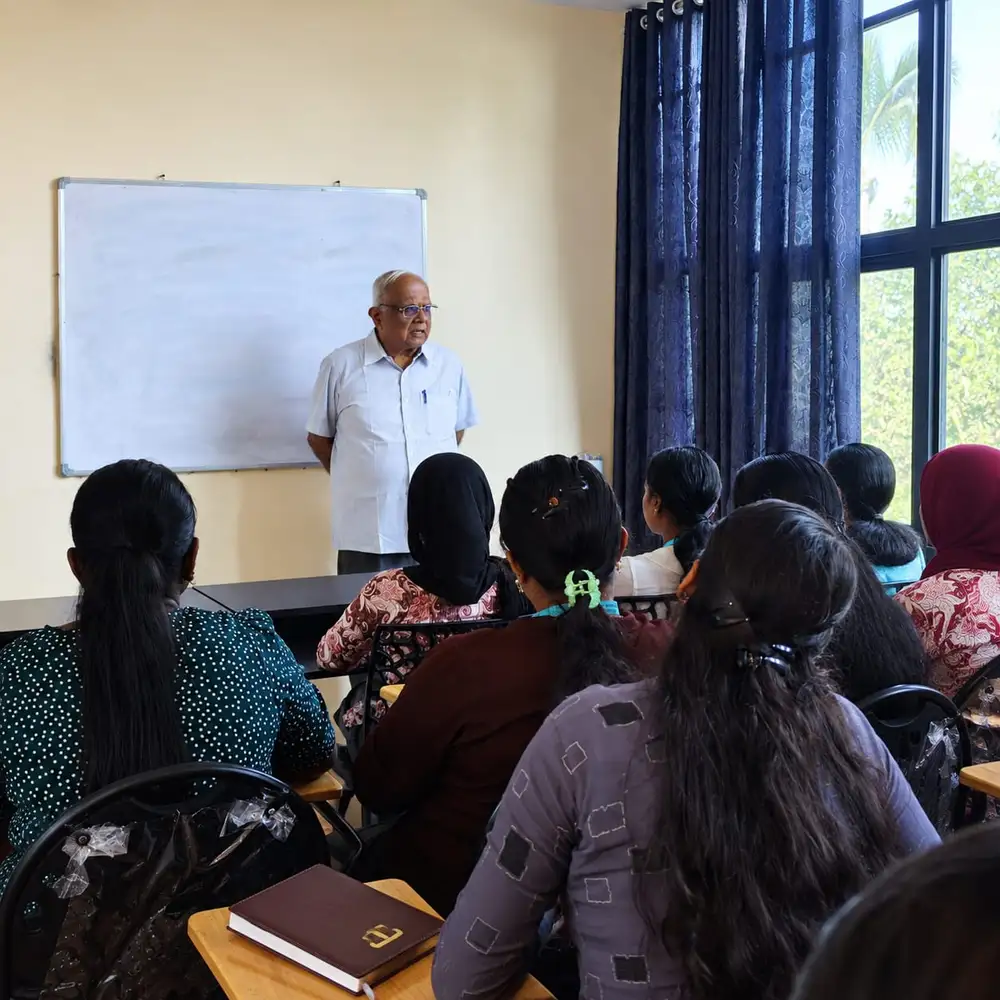
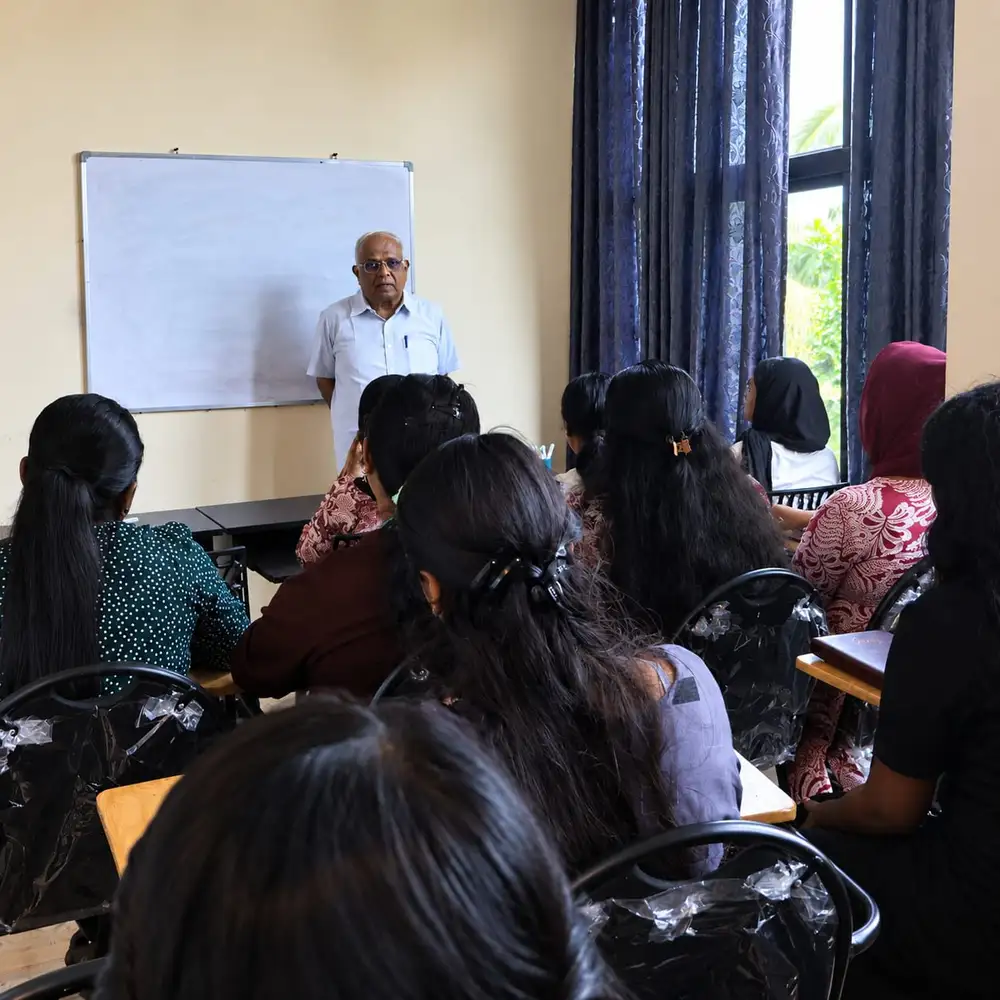
Hospital administration at Treneywann Management Studies (Vyttila, Kochi) is taught by retired hospital administrators — faculty who ran actual departments, set hiring criteria, and interviewed candidates for the same roles students will apply for. HOD B.V. Kumar (MHA, MBA, MA, PGDPR, PGDJ — 35+ years across India and the GCC) teaches every module from lived operational experience; mock interviews run in every batch. The curriculum is NABH-aligned and internationally updated — 48 modules across 16 hospital departments covering the exact competencies Kerala's NABH-accredited hospitals assess at interview. Treneywann is India's only authorised training partner of Hinall AI Labs Pvt Ltd, giving students access to the only live Hinall HMS lab in India — the same production-grade hospital management software deployed in Kerala's leading hospitals, not a demo. Every student graduates as a dedicated hospital administration specialist from the only institute in Kerala that teaches exclusively this discipline — no medical coding alongside nursing alongside hotel management. Students earn 5 certifications including a UGC-approved university credential and AI in Healthcare; the TTMSTRCT Diploma and the university certificate are embassy attestable for GCC employment. Fees: ₹37,000 (6-month Diploma) / ₹57,000 (1-year PG Diploma) — all-inclusive, no hidden charges. Zero-interest EMI: ₹7,000 first instalment then 5 × ₹6,000 (6-month); ₹5,000 first instalment then 10 × ₹5,200 (1-year). The ₹37,000 fee is typically recovered within two months of employment at Kerala's ₹18,000–25,000 fresher salary. Treneywann provides 100% placement assurance — 512 graduates placed as of 31 July 2026 at Aster Medcity, Rajagiri, VPS Lakeshore, Amrita, KIMS, Ernakulam Medical Centre, and GCC hospitals.

India's Only Live HMS Simulation Lab

Hands-On HMS Training — Real Software, Not Screenshots

Every student logs into live Hinall HMS — 48 NABH-aligned modules across 16 hospital departments. OPD, IPD, billing, TPA, pharmacy, MRD, OT — all practised on the same software running in Kerala's top hospitals before your first day at work.

Authorised by Hinall AI Labs Pvt Ltd — the only institute in Kerala officially authorised to run live HMS simulation training.

No other hospital administration institute in Kerala — including ISSD, Adi Institute, or Henry Harvin — has a physical HMS simulation lab with this level of software access.
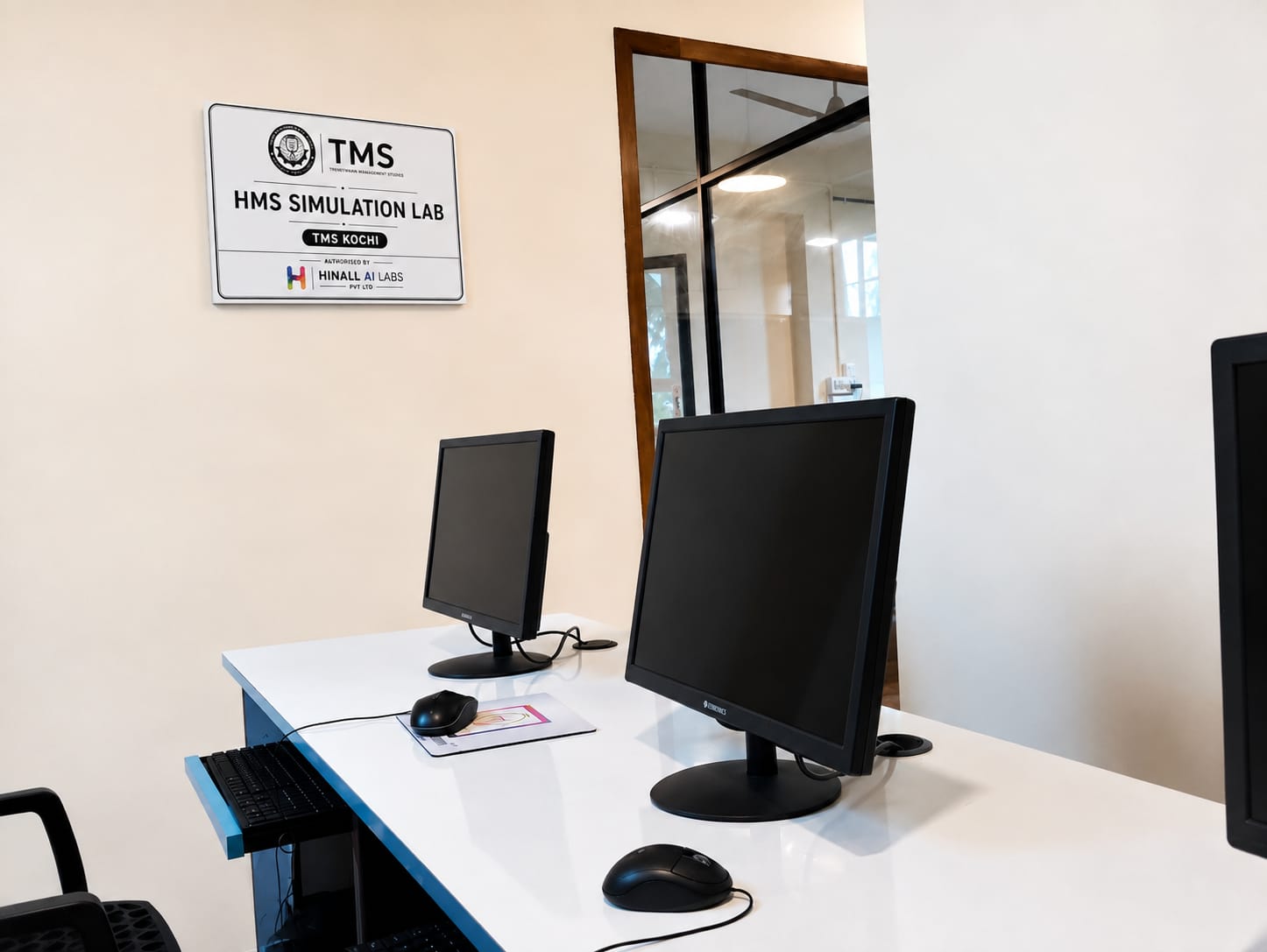
HMS Simulation Lab at Treneywann Management Studies Kochi — Authorised by Hinall AI Labs Pvt Ltd, Kerala's only live hospital management software training lab with 48 modules across 16 departments

TMS HMS Simulation Lab · Vyttila, Kochi · Authorised by Hinall AI Labs Pvt Ltd

UGC-Approved University Programme
NITI Aayog Darpan Listed
512 Graduates Placed
100% Placement Assurance
5 Certifications
Live HMS Lab

Why Choose TMS

What Makes Treneywann Different — 7 Verifiable Facts

No other institute in Kerala — or India — combines all seven of these. Check each one against any competitor before enrolling.

1

Only Live HMS Simulation Lab in India — Internationally Updated Curriculum

Treneywann is the only institute in India where the entire hospital administration curriculum runs inside live Hinall HMS software — 16 departments, 48 NABH-aligned practical modules. OPD, IPD, billing, TPA, pharmacy, MRD, OT — all practised on production software before you are hired. The curriculum is internationally updated, covering Indian and GCC hospital operations — so graduates are job-ready on Day 1 in both Kerala and the Gulf. No other institute in Kerala offers this.

2

Only Training Institute Exclusively for Hospital Administration

Treneywann teaches only hospital administration — no logistics, HR, oil & gas, or any other course. Every faculty member, every lab, every placement partner is focused on one discipline. Specialisation means depth. No multi-course institute can match this.

3

5 Certifications Including UGC University + Free AI in Healthcare Add-On

One fee. Five certificates: TTMSTRCT Council Trust Diploma, UGC-approved university certificate, AI in Healthcare Administration (a fully certified add-on module included free — not sold separately), Hinall HMS Proficiency, and HLP Virtual Hospital. The TTMSTRCT Diploma and UGC-approved university certificate are embassy attestable — valid for hospital jobs in UAE, Saudi Arabia, Qatar, and Oman. No extra charge, no opt-in required.

4

Only Institute Managed by Retired Hospital Administrators

Treneywann is not just taught — it is managed by retired hospital administrators. The curriculum, the HMS lab, the placement network, and the institute's direction are all set by people who have actually administered hospitals. No other institute in India makes this claim.

5

Classes by Retired Hospital Administrators — Including Mock Interviews & English

HOD B.V. Kumar (MHA, MBA, MA, PGDPR, PGDJ) — 35+ years across India and the GCC — teaches every module, combining classroom theory with live HMS practical. Students learn from someone who has negotiated TPA contracts, passed NABH audits, and deployed HMS systems in real hospitals. Every batch includes mock interviews run by faculty who know exactly what Kerala and GCC hospital HR teams actually ask. Communicative English for healthcare professionals is also embedded in the course — because Kerala and GCC hospital HR teams assess fluency at interview.

6

100% Placement Assurance — 512 Documented Placements (as of 31 July 2026)

Treneywann provides 100% placement assurance — not just assistance. 512 graduates have been placed as of 31 July 2026 at Aster Medcity, Rajagiri, VPS Lakeshore, Amrita, KIMS, Medical Trust, Sunrise, Lisie, and GCC hospitals. Named hospitals. Verifiable placements. Not an aggregate number across multiple courses.

7

Fully Transparent Fees — Nothing Hidden

₹37,000 for 6 months. ₹57,000 for 1 year. All-inclusive — 5 certificates, HMS lab, internship, study materials, uniform. Published openly on this website. No "contact for fee details." No hidden charges. Zero-interest EMI: ₹7,000 first instalment then 5 × ₹6,000 (6-month); ₹5,000 first instalment then 10 × ₹5,200 (1-year). Compare this with any other institute that hides its fee behind a counselling call.

Frequently Asked Questions

Everything you need to know before enrolling in hospital administration at Treneywann.

Which 3-month course is best in Kerala after Plus Two? +
There is no single best 3-month course, because three months buys a skill rather than a profession. The genuinely useful 3-month options in Kerala are accounting with Tally and GST, which suits Commerce students and leads to accounts assistant work at roughly 12,000 to 18,000 rupees a month, and logistics documentation, which is well placed around Kochi port and airport at roughly 14,000 to 20,000 rupees. Digital marketing can also be started in three months, but pay depends on the portfolio you build afterwards rather than on the certificate. Medical coding is often advertised as a 3-month course, although most students need closer to five or six months including certification preparation. If you want a hospital career rather than a single skill, the shortest credible route is a 6-month hospital administration programme, because a hospital desk role expects familiarity with several departments and with hospital software, which three months does not allow.
What is the cheapest short-term course in Kerala after Plus Two? +
Accounting with Tally and GST is normally the cheapest structured option in Kerala, commonly in the range of 6,000 to 20,000 rupees for two to four months. Basic computer and data entry courses are cheaper still, often under 10,000 rupees, but they also have the weakest earnings ceiling of the options on this page. Judge cost against what the course leads to rather than in isolation. A useful comparison is cost per month of study set against the first salary the course realistically leads to. A very cheap course that leads to 10,000 rupees a month is not cheaper in any meaningful sense than a mid-priced course that leads to 20,000 rupees a month.
Which short-term course has the best salary in Kerala? +
For a Plus Two fresher in Kerala, the highest starting bands among genuinely short courses are hospital administration at roughly 18,000 to 25,000 rupees a month and logistics at roughly 14,000 to 20,000 rupees. Nursing can start higher but is a two to three year clinical qualification rather than a short course. Digital marketing has the widest spread, with a small number of strong performers earning well above these bands and many earning below them, because pay follows demonstrable results. Starting salary is only half the question. Ask where the role sits after five years. Hospital administration and logistics both open supervisory and management steps, while data entry and basic accounting roles tend to stay close to where they started unless you add a further qualification.
Can I do a short-term course if I did not clear Plus Two? +
Yes. Most short-term courses in Kerala, including the hospital administration programme at Treneywann Management Studies in Kochi, will let you begin while your Plus Two is still incomplete. You can clear the pending papers through SAY, the supplementary or compartment examination, NIOS or the Kerala State Open School while you study. Be clear about one condition, because honest institutes state it in advance and others do not. Placement is tied to completing Plus Two. Hospitals verify the certificate at the time of joining, so the training can run in parallel but the qualification has to be finished before you can be placed.
Short-term course or a degree — which is better after Plus Two? +
They answer different questions, so the honest answer is that most students should not treat it as a choice. A degree is the right primary route if you want a government job through Kerala PSC, a professional qualification, postgraduate study or a role that legally requires a degree. A short-term course is the right first move if you need to be earning within the year, if funding a three-year degree is not realistic right now, or if you are not yet convinced by any degree subject. The strongest sequence for many Kerala students is to do both in order. Complete a short employment-focused course, start working, then take a distance or evening degree alongside the salary. You reach the same degree a few years later with work experience attached instead of none.
Are 6-month courses after 12th in Kerala enough to get a job? +
It depends entirely on whether the course ends in a named job role. Six months is enough time to become employable in hospital administration, logistics documentation, accounting or medical coding, because each of these has a defined entry designation that employers recruit for. Six months is not enough for any clinical role, because clinical work requires supervised patient contact and a regulated qualification. Before enrolling in any 6-month course, ask the institute to name the exact job title you will apply for on completion, the departments or companies that hire it, and how many of last year students are currently in that role. A course that cannot answer those three questions is selling a certificate rather than a career.
Which short-term course is best for Commerce and Humanities students without Science? +
Hospital administration, accounting with Tally and GST, logistics and digital marketing are all fully open to Commerce and Humanities students, and none of them require Biology, Physics or mathematics beyond ordinary arithmetic. Paramedical diplomas and nursing usually expect Science with Biology, so those doors are narrower without it. Commerce students in particular have an advantage in hospital billing, TPA and insurance processing, and in accounting roles, because both are built on invoicing, ledgers and reconciliation that they have already met at Plus Two.
Is hospital administration better than medical coding? +
Neither is better in the abstract, and they suit clearly different people. Medical coding is solitary, screen-based, precision work assessed on accuracy, usually in a coding or billing company, often on shifts aligned to overseas clients, and it rewards students who enjoy detail and rules. Hospital administration is coordination work inside a hospital, involving patients, doctors and departments all day, and it rewards students who are comfortable talking to people and handling several things at once. Choose coding if you would rather work with documents than with people. Choose administration if the reverse is true. Kerala starting salaries for the two are broadly comparable, so the decision should rest on the nature of the work, not on the numbers.
How long do short-term courses take after Plus Two in Kerala? +
Genuinely short courses run from about one month to one year. Data entry and basic computer courses take one to three months. Accounting with Tally and GST takes two to four months. Digital marketing, logistics and medical coding take three to six months. Hospital administration takes six months in the diploma format or one year in the extended format. Paramedical diplomas such as DMLT and radiology take one to two years and nursing routes such as GNM and ANM take two to three years, so those two categories are frequently listed as short courses but are not, and you should plan for the real duration when comparing them.
Can I take a short-term course while completing a degree in Kerala? +
Yes, and it is one of the most sensible things a Kerala student can do. Distance and evening degree formats leave enough room for a parallel skill course, and finishing your degree with a job-ready certification and hospital software experience already in hand puts you ahead of classmates starting their search from zero. Treneywann runs batches that students combine with a BA, BCom, BBA or BSc. Speak to the counsellor about timings before enrolling so the schedules genuinely fit rather than colliding at examination time.
What does the hospital administration course at Treneywann cost and how is it paid? +
The 6-month programme is 37,000 rupees all-inclusive, paid as 7,000 rupees at admission plus five monthly instalments of 6,000 rupees. The 1-year programme is 57,000 rupees all-inclusive, paid as 5,000 rupees at admission plus ten monthly instalments of 5,200 rupees. There is no lump-sum option and no separate charge for certification or the software lab. Both include 5 certifications, training on the live Hinall HMS lab covering 48 NABH-aligned modules across 16 hospital departments, and 100% Placement Assurance for Kerala students.
Who should not take a hospital administration course? +
Three groups should look elsewhere. If you want to treat patients, hospital administration is the wrong building to enter through, and nursing or a clinical paramedical diploma is the honest answer even though both take longer. If you want to write software or work in data and analytics, this is not a technology course and a computing route will serve you better. If you specifically need a degree, for a Kerala PSC post or for postgraduate study, then a degree has to be part of your plan, either instead of this course or alongside it. Hospital administration suits students who want a non-clinical hospital desk role quickly, are comfortable with people and paperwork together, and want a career ladder rather than a fixed job.

See These 7 Advantages in Person — Book a Free Session

Walk into the Vyttila campus. Sit at a live Hinall HMS terminal. Run a real patient registration. Meet B.V. Kumar. See the placement records. Then decide — no pressure.

📅 Book Free Session 📋 Enroll Now
📞 Call HA Specialist 💬 WhatsApp Us

2nd Floor Creative Tower, Near Vyttila Hub, Vyttila Junction, Kochi 682306  |  ₹37,000 (6 months)  ·  ₹57,000 (1 year)  ·  EMI from ₹7,000  ·  5 certificates  ·  AI in Healthcare add-on  ·  mock interviews  ·  100% placement assurance

📅 September 7 Batch — 9 AM  ·  11 AM  ·  2 PM  (Limited seats)   10 AM — FULL  ·  WhatsApp to confirm →

Why Hospitals Trust Our Graduates

✓ NITI Aayog Registered Trust
✓ ISO Certified Institute
✓ UGC-Approved University Programme
✓ 512 Graduates Placed — 100% Assurance

Our 100% Placement Assurance is a firm commitment backed by our record since 2020 — not a marketing phrase. Every graduate who completes the programme receives active support from our placement cell until placed. See our credentials →

Certificate awarded in partnership with a UGC-approved university.


Admissions Open
Sep 7 →
9–11 AM · 3 Seats Left 10 AM–12 PM · FULL 11 AM–1 PM · 2 Seats Left 2–4 PM · 3 Seats Left 6–7 PM Online · Limited 8–9 PM Online · Limited  ·  Sep 7, 2026 · Vyttila Kochi  · 
📱 Confirm Seat → Confirm →
📞 Call HA Specialist 💬 WhatsApp