.png)











50 Hospital Administration Interview Questions & Answers — 2026 Edition
Used by 512 graduates placed as of 31 July 2026 Treneywann graduates who walked into Aster, Rajagiri, VPS Lakeshore, and GCC hospitals ready from Day 1. Compiled by HOD B.V. Kumar — 35 years of real hospital administration experience across India and the GCC.
Hospital administration interviews in India consistently test five areas: NABH quality standards (accreditation chapters, incident reporting, patient safety), TPA and insurance processes (pre-authorization, cashless claims, rejection handling), hospital management software (HMS modules for OPD, IPD, and billing), core operations (census, bed occupancy, admission-discharge workflow), and patient relations (complaint handling and situational judgement). Freshers are also asked basics like the difference between OPD and IPD, what a medical record is, and biomedical waste classification under the BMW Rules 2016. This guide covers all 50 questions with model answers used by 512 graduates placed as of 31 July 2026 Treneywann graduates.
How to Use This Guide
This is not a list of questions to skim — it's a preparation system. Here's how to get the most from it:
- 50 questions, 5 categories. Fresher basics → operations → NABH quality → TPA & finance → leadership scenarios. Interviews for entry roles focus on Categories 1, 2, and 4; supervisory roles add 3 and 5.
- Each answer is what hospital HR panels actually want to hear. These are built from real interview debriefs of Treneywann graduates placed at Aster Medcity, Rajagiri, VPS Lakeshore, and GCC hospitals — not textbook definitions.
- Say the answers out loud. Reading an answer and delivering it under pressure are different skills. Practise each answer verbally at least twice.
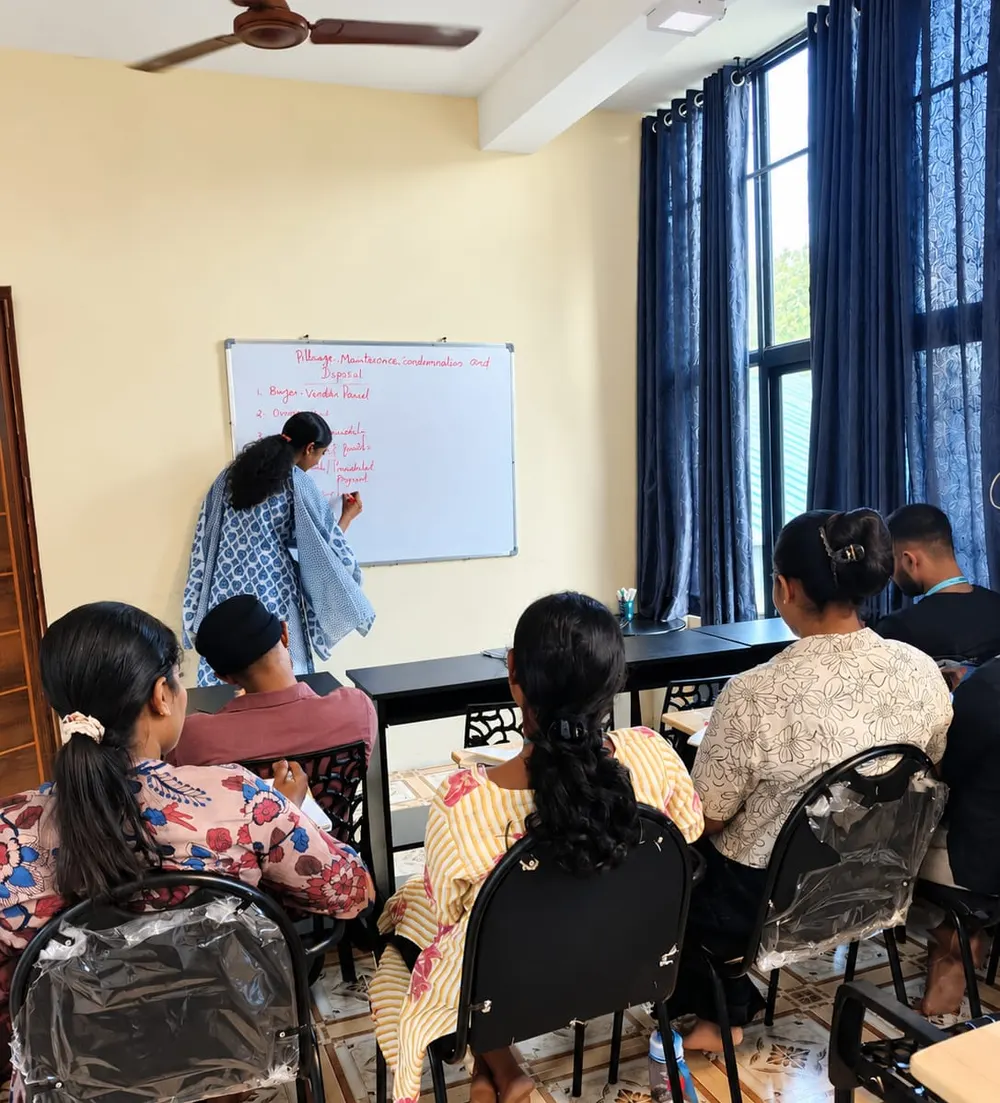
- Treneywann students go further: our course includes live mock interview sessions with actual hospital HR panels, video-recorded with feedback — so the real interview is never your first interview.
Category 1: Fresher & Basic Questions (Q1–Q10)
Every hospital administration interview starts here. These test whether you understand the field you are entering. Get these right and the panel relaxes; fumble them and nothing later saves you.
Q1. Tell me about yourself.
Structure it in three parts: education, training, and intent. Example: "I completed my degree in [stream], then trained in hospital administration at Treneywann Institute of Hospital Administration in Kochi, where I got hands-on practice on Hinall HMS across OPD, IPD, and billing modules, plus NABH and TPA training. I did my internship at a working hospital, and I'm now looking to start as a front office or floor executive where I can apply that training from day one." Keep it under 90 seconds and end with why you want THIS hospital — never recite your biodata line by line.
Q2. Why do you want to work in hospital administration?
Avoid the generic "I want to help people." Give a management-flavoured answer: "Healthcare is one sector where good management directly changes patient outcomes. I enjoy operations, coordination, and problem-solving, and hospital administration lets me do all three in an industry that is growing in Kerala and the GCC. I also like that it rewards system knowledge — HMS, NABH, TPA — which I have already trained in." Panels want to hear that you chose this deliberately, not as a backup.
Q3. What is hospital administration?
Hospital administration is the management of everything non-clinical in a hospital: patient flow (OPD/IPD), front office, billing and insurance, medical records, quality and NABH compliance, housekeeping, staffing, and vendor management. The administrator is the bridge between clinical teams (doctors, nurses) and management. A crisp closing line: "Doctors treat the patient; administrators make sure the hospital works so that treatment can happen smoothly."
Q4. What is the difference between a hospital and a clinic?
A clinic provides outpatient consultation and minor procedures — no admission, no beds. A hospital provides both outpatient (OPD) and inpatient (IPD) care with beds, 24×7 nursing, emergency services, operation theatres, pharmacy, and diagnostics. Administratively, a hospital needs bed management, admission-discharge-transfer (ADT) processes, IPD billing, and statutory compliance (fire safety, BMW, NABH) that a clinic does not.
Q5. What are OPD and IPD?
OPD (Out-Patient Department) — patients who consult and leave the same day. Flow: registration → token → consultation → pharmacy/lab → exit. IPD (In-Patient Department) — patients admitted to a bed. Flow: admission → bed allocation → treatment → interim billing → discharge → final bill. Add one operational insight to stand out: "OPD is high-volume and speed-driven; IPD is longer-cycle and revenue-heavy, so billing accuracy and bed management matter most there."
Q6. What is NABH? Is your target hospital NABH accredited?
NABH is the National Accreditation Board for Hospitals and Healthcare Providers — India's national quality accreditation body, functioning under the Quality Council of India. Accreditation certifies the hospital meets standards for patient safety, infection control, and documentation across 10 chapters. Before any interview, check the hospital's website for its NABH status — mentioning "I saw that your hospital is NABH accredited, and I've been trained on NABH documentation" is one of the highest-impact lines a fresher can deliver.
Q7. What is a TPA in healthcare?
A TPA (Third Party Administrator) is an IRDAI-licensed intermediary between the insurance company, the hospital, and the patient. The TPA processes cashless approvals (pre-authorization), verifies treatment against the policy, and settles claims with the hospital. Examples: Medi Assist, MDIndia, Vidal Health, Paramount. The hospital's TPA desk handles pre-auth forms, query responses, discharge approvals, and claim submission — one of the most in-demand roles for freshers.
Q8. What is a medical record and why is it important?
A medical record is the complete documented history of a patient's care: admission notes, doctor's orders, nursing notes, lab reports, consent forms, operation notes, and discharge summary. It matters for four reasons: continuity of care, legal protection (records are court-admissible evidence in medicolegal cases), insurance claims (TPAs reject claims with incomplete records), and NABH compliance. Records must typically be preserved for years — OPD records commonly 3 years and IPD/MLC records much longer per hospital policy and state rules.
Q9. What hospital software/HMS have you used?
This question separates trained candidates from everyone else. A strong answer: "I trained hands-on on Hinall HMS at Treneywann — a live HMS used by working Kerala hospitals — across 48 modules across 16 departments including OPD registration, IPD admission and bed management, billing, pharmacy, lab, and MIS reports. I've done actual patient registration entries, TPA billing, and daily census reports on it, so I can adapt quickly to whichever HMS your hospital uses, since all HMS platforms share the same core workflow."
Q10. What is biomedical waste? How is it classified?
Biomedical waste (BMW) is waste generated during diagnosis, treatment, or immunisation. Under the BMW Rules 2016, it is segregated at source into colour-coded categories: Yellow — infectious and anatomical waste, soiled dressings, expired medicines; Red — contaminated recyclable plastics (tubing, syringes without needles); White (translucent) — sharps including needles and blades; Blue — broken glassware and metallic implants. Mention that segregation happens at the point of generation, staff must be trained annually, and BMW compliance is checked in every NABH audit.
Category 2: Clinical Knowledge & Operations (Q11–Q20)
These questions test whether you can actually run a hospital floor. Panels use them to check if your training included real operations exposure or just theory.
Q11. Explain the patient admission process step by step.
(1) Doctor advises admission and issues an admission order with provisional diagnosis. (2) Front office/admission desk verifies patient identity and collects demographic details. (3) Bed is allocated in the HMS based on category (general/semi-private/private/ICU) and availability. (4) Consent forms are signed; for insurance patients, the TPA desk initiates pre-authorization. (5) Advance/emergency deposit is collected for cash patients. (6) A unique IP number is generated, the patient file is opened, and the patient is shifted to the ward with a nurse handover. Naming the HMS steps ("the ADT module") shows practical training.
Q12. What is the role of the Front Office in a hospital?
The front office is the hospital's face and its first operational checkpoint: patient registration (new UHID creation), OPD token issue, appointment scheduling, enquiry handling, admission coordination, billing queries, and telephone management. It also does soft triage — directing emergencies to casualty immediately. Because 80% of patient complaints originate from front-office friction (waiting time, billing confusion, poor communication), hospitals hire specifically for communication skill plus HMS registration-module competence.
Q13. What is CSSD and why is it critical?
CSSD is the Central Sterile Supply Department — it cleans, disinfects, sterilises, and distributes surgical instruments and linen for OT and wards. It typically runs three zones (dirty/receiving, clean/packing, sterile/storage) with one-way flow to prevent recontamination. It is critical because CSSD failure causes surgical site infections — a direct patient-safety and NABH issue. An administrator monitors CSSD indicators like sterilisation cycle records, biological indicator results, and instrument turnaround time.
Q14. What is census in hospital administration?
The census is the count of inpatients occupying beds at a fixed time — usually midnight ("midnight census"). It drives everything the next morning: bed availability, nurse-patient ratio planning, kitchen/diet orders, and revenue projection. The daily census report from the HMS typically shows admissions, discharges, transfers, deaths, and current occupancy per ward. If you can say "my day would start with the census report on the HMS dashboard," you sound like someone who has already worked a shift.
Q15. What is the difference between bed occupancy rate and bed turnover rate?
Bed Occupancy Rate (BOR) = (occupied bed-days ÷ available bed-days) × 100 — it shows how full the hospital is; 75–85% is generally considered healthy. Bed Turnover Rate (BTR) = number of discharges ÷ number of beds in a period — it shows how many patients each bed served. A hospital can have high BOR but low BTR (patients staying too long — check ALOS) or high BTR with moderate BOR (fast, efficient short-stay care). Explaining that relationship, not just the formulas, is what impresses panels.
Q16. What is an MLC case? What is the hospital's duty?
An MLC (Medico-Legal Case) is any case with potential legal implications — road traffic accidents, assault, poisoning, burns, suicide attempts, industrial injuries. The hospital's duties: treat first (emergency care can never be denied or delayed for legal formalities), inform the police, register the case in the MLC register, document meticulously, preserve evidence, and release records only through proper legal channels. MLC records get extended preservation. Administrators coordinate the documentation and police communication — never the clinical judgement.
Q17. What is discharge against medical advice (DAMA)?
DAMA (also called LAMA — Left Against Medical Advice) is when a patient or family insists on discharge despite the doctor advising continued treatment. The administrator's process: ensure the doctor explains the risks, obtain a signed DAMA consent form documenting that risks were explained, complete billing, document everything in the medical record, and never obstruct the patient's legal right to leave. The signed DAMA form protects the hospital legally — an unsigned DAMA is an administrator's failure, not the patient's.
Q18. What is the role of the Medical Records Department?
MRD manages the lifecycle of patient records: assembling files after discharge, checking completeness (deficiency check — missing signatures, incomplete discharge summaries), coding diagnoses (ICD), indexing, storage and retrieval, statistics and reporting (census, ALOS, mortality data), and controlled release of records for insurance, legal, or patient requests. MRD is also the custodian of records in court cases. In NABH hospitals, MRD audits are routine, and MRD Officer is a common first job for hospital administration graduates.
Q19. What is ICD coding? Have you encountered it?
ICD (International Classification of Diseases, currently ICD-10 moving to ICD-11) is the WHO system that assigns standardised alphanumeric codes to every diagnosis — e.g., dengue fever has a specific code rather than free text. Hospitals use ICD codes in medical records for statistics, insurance claims, and government reporting; miscoding causes claim rejections. As a fresher you are not expected to be a certified coder — say you understand the purpose, encountered it in your MRD module training, and are willing to learn the hospital's coding workflow.
Q20. What is a duty roster and how is it prepared?
A duty roster is the shift-wise staff allocation plan — typically morning, evening, and night shifts with weekly offs. Preparation principles: adequate coverage per shift based on patient load and nurse-patient ratios, fair rotation of nights and Sundays, compliance with working-hour rules, planned leave adjustment, and a float/reserve arrangement for sudden absences. It is prepared in advance (usually weekly or monthly), published transparently, and changes are documented. Mention that a good roster prevents both understaffing (patient risk) and overstaffing (cost) — that balance is the administrator's job.
Category 3: Quality & NABH Questions (Q21–Q30)
NABH-accredited hospitals — which include most large Kerala and all serious GCC-feeder hospitals — test quality knowledge hard. This is where trained candidates pull decisively ahead.
Q21. What are the 10 chapters of NABH standards?
The NABH hospital standards are organised into 10 chapters — five patient-centred: AAC (Access, Assessment and Continuity of Care), COP (Care of Patients), MOM (Management of Medication), PRE (Patient Rights and Education), HIC (Hospital Infection Control); and five organisation-centred: PSQ (Patient Safety and Quality Improvement), ROM (Responsibilities of Management), FMS (Facility Management and Safety), HRM (Human Resource Management), IMS (Information Management System). You don't need every clause memorised — naming the chapters and saying which ones an administrator touches daily (AAC, PRE, FMS, IMS) is a complete answer.
Q22. What is a root cause analysis (RCA) in a hospital context?
RCA is a structured investigation into why an adverse event happened — going past the immediate mistake to the system failure underneath. Common tools: the "5 Whys" and the fishbone (Ishikawa) diagram. Example: a patient fall → why? floor was wet → why? housekeeping mopped without a caution board → why? boards were short in stock → root cause: procurement gap, not the housekeeping staff. The key sentence panels want to hear: "RCA fixes systems, not blames individuals — that's what makes staff report incidents honestly."
Q23. What is an incident report? Give an example.
An incident report documents any unplanned event that harmed or could have harmed a patient, visitor, or staff member — medication errors, patient falls, needle-stick injuries, equipment failure, wrong-patient events. It records what happened, when, who was involved, immediate action taken — factually, without blame. Near-misses are reported too, because they predict future harm. Reports go to the quality department for trending and RCA. Example: "A nurse notices two look-alike drug vials stored together and one nearly administered wrongly — that near-miss gets reported, and pharmacy changes the storage."
Q24. What is patient safety and why is it a priority?
Patient safety means preventing avoidable harm during care — wrong medication, wrong-site surgery, hospital-acquired infections, falls, misidentification. It is priority one because the first principle of healthcare is "do no harm," and because failures cost lives, litigation, licence, and reputation. Mention the International Patient Safety Goals (IPSG): correct patient identification (two identifiers), effective handover communication, high-alert medication safety, safe surgery checklists, hand hygiene, and fall-risk reduction. Administrators enable these through systems — ID bands, checklists, audits — not clinical acts.
Q25. What is a clinical audit?
A clinical audit compares actual practice against a defined standard, then closes the gap. Cycle: choose a topic (e.g., antibiotic prescribing before surgery), set the standard, measure current practice from records, identify gaps, implement changes, and re-audit. It differs from research — research asks "what is the right practice?"; audit asks "are we following the right practice?" Administrators support audits by pulling data from HMS and MRD, scheduling audit meetings, and tracking whether corrective actions actually happened.
Q26. What is the difference between NABH and JCI accreditation?
NABH is India's national accreditation (under the Quality Council of India); JCI (Joint Commission International) is the US-based global accreditation used by top international hospitals, including many in the GCC. Both assess patient safety and quality; JCI is broader, costlier, and internationally benchmarked, while NABH is tailored to Indian regulation and required for many Indian insurance/government empanelments. For a Kerala candidate eyeing the Gulf: "NABH experience in India maps closely to JCI expectations in GCC hospitals" is a strong closing line.
Q27. What are the key quality indicators in a hospital?
Commonly tracked quality indicators: hospital-acquired infection rates (surgical site, catheter-associated UTI, ventilator-associated pneumonia), medication error rate, patient fall rate, average waiting time in OPD and emergency, patient satisfaction score, mortality rates, return-to-OT/re-admission within a defined period, and documentation completeness (consent, discharge summary timeliness). Each indicator has a numerator, denominator, and monthly trend reviewed in the quality committee. Saying "an indicator without a trend and an action is just a number" shows maturity.
Q28. What is a sentinel event?
A sentinel event is an unexpected occurrence involving death or serious permanent harm unrelated to the natural course of illness — wrong-site surgery, retained instrument after surgery, transfusion of incompatible blood, infant abduction, patient suicide in the facility. "Sentinel" means it signals a critical system failure demanding immediate response: report at once, contain, conduct a mandatory RCA within a defined timeframe, and implement corrective action. Distinguish it clearly from routine incidents — sentinel events are the rare, most severe category with mandatory RCA.
Q29. How do you handle a NABH documentation audit?
Preparation is continuous, not last-minute: keep SOPs current and signed, records complete in real time, and staff trained on their own SOPs. During an audit: accompany the assessor, present documents in the organised master file structure, answer only what is asked — honestly, and if something is missing, say so and show the corrective plan rather than improvising. After: log non-conformities, assign owners and deadlines for corrective and preventive actions (CAPA), and verify closure. The line that lands: "An audit finding is a free consultancy report — the mistake is hiding gaps, not having them."
Q30. What is a patient satisfaction survey and how is it used?
A structured feedback tool given to patients at or after discharge covering admission experience, staff behaviour, cleanliness, food, billing transparency, and overall likelihood to recommend. Administrators compile scores monthly, trend them by department, and act on the lowest scorers — e.g., billing confusion consistently scoring low triggers a billing-counter redesign or an itemised-bill explainer. Closing the loop matters: contacting dissatisfied patients converts complainants into loyalists, and NABH expects documented evidence that feedback led to action.
Category 4: TPA & Finance Questions (Q31–Q40)
The TPA desk and billing department are where hospitals make or lose money — and where freshers get hired fastest. Expect at least 3–4 questions from this set in any front-office or billing interview.
Q31. Walk me through the TPA pre-authorization process.
(1) Patient presents insurance card/policy details at admission or the TPA desk. (2) Desk verifies policy validity, sum insured, and whether the hospital is in the insurer's network. (3) Pre-auth form is filled with patient details, provisional diagnosis, planned treatment, and estimated cost — signed by the treating doctor. (4) Form plus ID and initial reports are sent to the TPA (usually via portal). (5) TPA may approve, query, or partially approve; queries are answered with additional clinical documents. (6) Approved amount is communicated to patient and billing; enhancement requests are raised if costs rise mid-treatment. (7) At discharge, final documents go for discharge approval before the patient leaves cashless.
Q32. What is cashless hospitalization?
Cashless means the insurer/TPA settles the approved bill directly with the hospital, so the patient pays only non-covered items (non-medical consumables, amounts above the approved limit, co-pay). It requires the hospital to be in the insurer's network and pre-authorization to be approved. Contrast it with reimbursement, where the patient pays the full bill and claims money back later. Note the administrator's duty: clearly explain to the patient at admission what will NOT be covered — surprise deductions at discharge are the single biggest source of billing complaints.
Q33. What is the difference between CGHS and ESI?
CGHS (Central Government Health Scheme) covers central government employees, pensioners, and dependents — treatment at CGHS-empanelled private hospitals at fixed CGHS package rates, usually via referral. ESI (Employees' State Insurance) is a statutory social-security scheme for lower-wage private-sector employees, funded by employer-employee contributions, providing care through ESI hospitals and tie-up hospitals. For the hospital, both mean: empanelment paperwork, scheme-specific rate cards lower than regular tariff, referral validation, and separate billing queues — which is why hospitals staff dedicated scheme desks.
Q34. What is revenue cycle management?
RCM is the full financial journey of a patient encounter: registration and insurance capture → accurate service charging (every lab test, drug, procedure posted to the bill) → interim billing → pre-auth and enhancement management → discharge billing → claim submission with complete documents → payment posting → denial/rejection follow-up → receivables reporting. Leakage points an administrator watches: unbilled services (missed charge capture), delayed claim submission, incomplete documents causing rejections, and unreconciled TPA payments. "Charge capture is where hospitals silently lose money" is an answer that sounds like experience.
Q35. What is the role of the billing department?
Billing converts care into accurate, transparent invoices: OPD billing (consultation, diagnostics, pharmacy), IPD interim and final bills, package management (fixed-price surgeries), scheme/TPA billing at contracted rates, refunds and adjustments, and daily cash/collection reconciliation. It coordinates constantly with wards (service capture), TPA desk (approved amounts), and MRD (supporting documents). Key skills: HMS billing-module mastery, tariff knowledge, and the communication ability to explain a bill line-by-line to an anxious family — billing is as much a patient-relations job as a finance job.
Q36. What are common rejection reasons for TPA claims?
Top rejection/denial causes: policy exclusions (treatment not covered, waiting period not completed for pre-existing disease), non-disclosure of pre-existing conditions, incomplete documentation (missing discharge summary, reports, or signatures), diagnosis-treatment mismatch, billing above approved/package amount, late claim submission beyond the deadline, and treatment at a non-network hospital claimed as cashless. Prevention is the administrator's job: verify policy at admission, document in real time, answer TPA queries fast, and submit complete files. A rejected claim usually means a hospital process failed — not just bad luck.
Q37. What is a tariff in a hospital? How is it set?
The tariff is the hospital's official rate card — room rents by category, consultation fees, procedure charges, OT charges, diagnostics, and packages. It is set considering costs (staff, consumables, equipment amortisation), market benchmarking against comparable hospitals, payer mix, and scheme rates (CGHS/ESI/insurance-negotiated rates differ from the rack tariff). Room-rent category often drives other charges proportionally ("bed-category linked billing"). Administrators must know the tariff cold — quoting wrong estimates at admission causes the worst discharge-time disputes.
Q38. What is an emergency deposit and when is it collected?
An advance collected at or shortly after admission from cash (non-insurance) patients against the estimated treatment cost — adjusted in the final bill. Critical legal-ethical point that panels listen for: emergency treatment can never be denied or delayed for want of a deposit; stabilise first, discuss money after. Practically: give a realistic estimate, collect a reasonable advance, top up via interim bills as treatment extends, and document all financial counselling. For insurance patients, the pre-auth substitutes for the deposit except for predictable non-covered amounts.
Q39. What is the difference between final bill and summary bill?
The final bill is the complete itemised invoice at discharge — every drug, test, consumable, room-day, and procedure with dates and rates, after adjusting advances and approvals. A summary bill condenses that into category-wise totals (room rent, pharmacy, lab, professional fees, OT) on one page — used for TPA submission, quick patient explanation, and reimbursement claims. Patients and TPAs typically get both: the summary for readability, the itemised bill for verification. Knowing that TPAs demand the itemised bill with the discharge summary shows desk-level familiarity.
Q40. What is CGHS empanelment and why do hospitals seek it?
Empanelment is the process by which a private hospital gets approved to treat CGHS beneficiaries at fixed CGHS rates — involving application, quality criteria (NABH accreditation earns better rates), rate agreement, and periodic renewal. Hospitals seek it despite lower rates because it delivers assured patient volume (a large pensioner/government population, especially in Kerala), steady referral flow, and credibility. The trade-off an administrator manages: scheme patients at discounted rates fill beds and cover fixed costs, while cash and insurance patients carry margins — payer-mix balancing in action.
Category 5: Leadership, HR & Situational Questions (Q41–Q50)
No right answers exist here — panels are watching HOW you think: calm, structured, patient-first, and escalating at the right level. Use the pattern: assess → act → communicate → document → prevent.
Q41. How would you handle a conflict between a doctor and a nurse?
First, separate the conflict from patient care — ensure the patient in question is being attended. Speak to each person privately, not in the corridor and never in front of patients. Establish facts, identify whether it is a process issue (unclear orders, handover gap) or a personal one, and resolve process issues by fixing the system. If it involves clinical judgement, escalate to the medical superintendent — an administrator mediates behaviour and process, never clinical decisions. Document if formal, and follow up in a week to confirm the working relationship recovered.
Q42. A patient's family is shouting at the front desk. What do you do?
Move fast — visible anger in a lobby escalates and spreads. Approach calmly, introduce yourself, and move them to a private area ("Let's sit where I can understand this properly"). Let them vent fully without interrupting; most anger drops 50% just from being heard. Acknowledge the frustration without prematurely admitting fault, get the facts, fix what is fixable now (a status update from the ward, a billing clarification), and give a specific commitment with a time ("I will come back to you in 20 minutes"). Log it, follow through, and alert security discreetly only if there is a physical threat.
Q43. How would you reduce patient waiting time at OPD?
Diagnose before prescribing: pull HMS data to find WHERE the wait is — registration, consultation, lab, pharmacy? Then apply targeted fixes: appointment/slot systems and teleconsultation-booking to smooth arrival peaks, dedicated counters for follow-up/report-only patients, doctor-punctuality monitoring (the most common and most avoided root cause), token displays with realistic time estimates so waiting feels managed, and phlebotomy/pharmacy staffing matched to the 9–11 AM surge. Measure again after changes. Answering with "first I'd measure" instead of a list of guesses is what separates managers from freshers.
Q44. A key staff member calls in sick on a busy Sunday. What do you do?
Immediate triage: what functions does that person cover, and which cannot wait? Activate the standing options in order — on-call/float staff, shift extension for the outgoing person (with consent and comp-off), redistributing critical tasks among present staff, or stepping in personally for coverable duties. Inform affected departments so expectations adjust. Afterwards, the real answer: one sick call should never create a crisis — maintain a float pool, cross-train staff on critical functions, and keep an updated emergency contact roster. Panels want the prevention thinking, not just the firefighting.
Q45. How would you improve patient satisfaction scores?
Start with the data: which questions score lowest — waiting time, staff communication, billing clarity, cleanliness? Attack the top two drivers rather than everything at once. Typical high-yield moves: hourly "comfort rounds" in wards, a discharge-time guarantee (discharge within a set time of the doctor's order — discharge delay is Kerala's most common complaint), billing counselling before discharge, and staff communication training with scripts for high-friction moments. Close the loop with unhappy patients personally. Re-survey and publish the trend to staff — scores improve when staff see them.
Q46. What is your leadership style?
Avoid buzzword-only answers. A credible fresher answer: "Situational — I adapt to what the moment needs. In an emergency or audit, I'm directive: clear instructions, no debate. In routine operations, I'm collaborative — the front-office staff often know the bottleneck better than a report does. With juniors, I coach rather than command." Add one honest development point ("I'm still building the experience to delegate confidently") — self-aware beats superhuman in every HR panel.
Q47. How do you prioritize when everything is urgent?
Give a rule, then an example. Rule: patient safety first, always; then legal/compliance deadlines; then revenue-critical items; then everything else — importance beats loudness. Example: "If a ward reports an oxygen supply issue, a TPA deadline expires in an hour, and a VIP visitor is waiting — oxygen gets me personally, the TPA file gets delegated with a check-back time, the VIP gets a polite message with an ETA." Mention delegation explicitly: prioritising does not mean doing everything yourself in sequence; it means routing tasks to the right people simultaneously.
Q48. A vendor is late with a critical medical supply. What do you do?
Contain first: check current stock and realistic burn rate — how many hours or days of buffer exist? Activate alternatives in parallel: emergency local purchase, borrowing from a nearby sister hospital or pharmacy network, and escalating with the vendor for a firm revised delivery time in writing. Inform clinical teams if any rationing or substitution is needed — silently hoping is not a plan. Afterwards: review why a critical item had no reorder-level trigger, set minimum stock levels in the HMS pharmacy/store module, and maintain two approved vendors for every critical supply.
Q49. How do you handle a media inquiry during a hospital crisis?
One rule above all: never speak to media yourself unless you are the authorised spokesperson. Politely take the journalist's details, commit to a response through the official channel, and immediately inform management/the designated spokesperson. Internally: brief staff that no one comments or shares on social media, protect patient confidentiality absolutely (no names, no condition details — legal and ethical), and help management issue a factual, timely statement, because silence gets filled by speculation. Document the timeline. Panels ask this to test discretion — the wrong answer is any version of "I would explain our side to the reporter."
Q50. Where do you see yourself in 5 years in hospital administration?
Show a ladder, not a fantasy: "Year one, I want to master the ground level — front office or floor operations, HMS fluency, and this hospital's SOPs. By year two or three, I want ownership of a vertical like the TPA desk or quality documentation, and to have been part of an NABH assessment cycle. By year five, an Assistant Manager – Operations role where I'm running a department and mentoring freshers." If GCC is the goal, say it honestly: "Long-term I'm interested in Gulf opportunities, and I know 3–4 years in a NABH-accredited Indian hospital is the strongest route there." Ambition with a realistic path is exactly what panels reward.
Treneywann's Mock Interview Program — Practise Before It Counts
Reading 50 answers prepares your knowledge. Mock interviews prepare you. Every Treneywann student goes through structured interview training before placement.
🎤 Real Hospital HR Panels
Mock interviews are conducted by HR professionals from partner hospitals — not just faculty. You face the same style of questioning, follow-ups, and pressure you'll meet in the actual room.
🎥 Video Recording + Feedback
Every mock session is recorded. You review your own body language, filler words, and answer structure with a mentor — the fastest way to fix habits you don't know you have.
🏥 Real Questions from Real Hospitals
Our question bank — including this page — is continuously updated from debriefs with graduates interviewed at Aster, Rajagiri, VPS Lakeshore, and GCC hospitals. You prepare for what is actually asked.
🗣️ Communicative English Module
Most Kerala candidates know the answers but hesitate in English. Our communicative English module builds interview fluency and confidence — the difference between knowing and convincing.
✅ The Result: 512 graduates placed as of 31 July 2026
512 graduates placed as of 31 July 2026 Treneywann graduates placed, backed by a 100% placement assurance assurance — and a 4.9/5 student rating. Interview preparation is a core reason why.
Quick Reference Card — Night-Before Revision
Screenshot or print this. If you know every term in this table, you can handle 80% of any hospital administration interview.
Frequently Asked Questions
What is hospital administration and what does a hospital administrator do?
Hospital administration is the management of the non-clinical side of a hospital — operations, staffing, billing, quality, patient flow, and compliance. A hospital administrator ensures OPD and IPD run smoothly, coordinates between doctors, nurses, and management, handles TPA and insurance processes, maintains NABH quality standards, and operates hospital management software (HMS). It's a management career in healthcare that does not require MBBS.
What is NABH and why is it important for hospital administration?
NABH (National Accreditation Board for Hospitals and Healthcare Providers) is India's national quality accreditation body for hospitals. Accreditation certifies that a hospital meets defined standards for patient safety, infection control, documentation, and clinical quality across 10 chapters. Administrators handle NABH documentation, audits, incident reporting, and SOP compliance — making NABH one of the most tested topics in hospital administration interviews.
What is a TPA coordinator and how does pre-authorization work?
A TPA (Third Party Administrator) coordinator manages the interface between the hospital and insurance companies. In pre-authorization, the coordinator collects the patient's insurance card and ID, fills the pre-auth form with the provisional diagnosis and estimated cost from the treating doctor, sends it to the TPA, follows up for approval, and communicates the approved amount to the patient and billing team before cashless treatment begins.
What is the difference between OPD and IPD in hospital management?
OPD (Out-Patient Department) handles patients who consult a doctor and leave the same day — registration, token, consultation, pharmacy, diagnostics. IPD (In-Patient Department) handles patients admitted to a bed — admission, bed allocation, daily care, billing, and discharge. OPD is volume-driven and fast; IPD involves bed management, longer billing cycles, and insurance coordination.
What is revenue cycle management in a hospital?
Revenue cycle management (RCM) is the end-to-end process of capturing, billing, and collecting revenue for hospital services — from patient registration and service charging to claim submission, payment posting, and denial management. Good RCM means every service is billed accurately, TPA claims are submitted on time with complete documentation, rejections are minimised, and outstanding receivables are tracked daily through the HMS.
What is Hinall HMS and have you used any hospital management software?
Hinall HMS is a hospital management software used by working hospitals in Kerala, covering 48 modules across 16 departments including OPD, IPD, billing, pharmacy, laboratory, medical records, and MIS reporting. Treneywann runs Kerala's only live Hinall HMS training lab, so our students answer this question with hands-on module experience — real patient registration entries, bed allocation, TPA billing, and daily census reports — instead of theory.
How would you handle a patient complaint at the front desk?
Listen fully without interrupting, stay calm, and acknowledge the inconvenience. Move the conversation to a quieter area if the patient is upset, gather facts, and resolve what is within your authority immediately. If it's beyond your level, escalate to the duty manager, log the complaint in the grievance register or HMS, and follow up with the patient so they know the outcome.
What is biomedical waste management and the BMW Rules 2016?
Biomedical waste is any waste generated during diagnosis, treatment, or immunisation — used needles, dressings, body fluids, expired medicines, lab waste. The BMW Rules 2016 mandate segregation at source into colour-coded bins: yellow (infectious/anatomical), red (contaminated plastics), white (sharps), blue (glassware). Hospitals must maintain records, train staff, and hand waste to authorised treatment facilities — and NABH audits check this.
What are the key indicators (KPIs) for measuring hospital performance?
The most common hospital KPIs are Bed Occupancy Rate (BOR), Average Length of Stay (ALOS), bed turnover rate, OPD-to-IPD conversion rate, average patient waiting time, patient satisfaction score, hospital-acquired infection rate, TPA claim rejection rate, and average revenue per occupied bed. Administrators track these daily or monthly through HMS MIS reports.
Where do you see yourself in 5 years in hospital administration?
A strong answer shows a realistic growth path: start as a Front Office Executive or Floor Manager, master HMS software and NABH processes in the first two years, take ownership of a department such as TPA or quality, and grow into an Assistant Manager or Operations Manager role by year five. Candidates targeting GCC hospitals can add that they plan to gain NABH-accredited hospital experience in India first — Gulf employers value it highly.
Don't Just Read the Answers — Rehearse Them Live
Every Treneywann hospital administration student gets live mock interview sessions with hospital HR panels, video feedback, communicative English training, and a 100% placement assurance — all included in the course fee.
₹37,000 (6 Months Hospital Administration Course) | ₹57,000 (1-Year PG Diploma) — all-inclusive, no hidden charges. Hybrid mode available across Kerala.
Treneywann Institute of Hospital Administration · Office 49/A, Creative Tower, 2nd Floor, Near Kaniyampuzha Road, Eroor South, Vyttila, Ernakulam, Kerala 682306
Continue Your Preparation
🏥 Hospital Administration Hub
Everything about the field — courses, careers, salaries, and how to start.
🧭 Career Guide
Roles, growth paths, and how to plan your first 5 years in hospital administration.
🎓 Course in Kerala
The full Treneywann diploma — syllabus, HMS lab, placement assurance, and fees.
📚 Syllabus
Module-by-module breakdown of what you'll study — including everything tested in interviews.
📍 Course in Kochi
Study at our Vyttila campus — India's only live Hinall HMS lab.
💻 Hinall HMS — 48 Modules, 16 Departments
The software training that answers interview Question 9 before it's asked.
💰 Course Fees
Transparent all-inclusive fees — ₹37,000 (6M) and ₹57,000 (1Y), EMI available.