Who teaches the hospital administration course at Treneywann in Kerala?
+
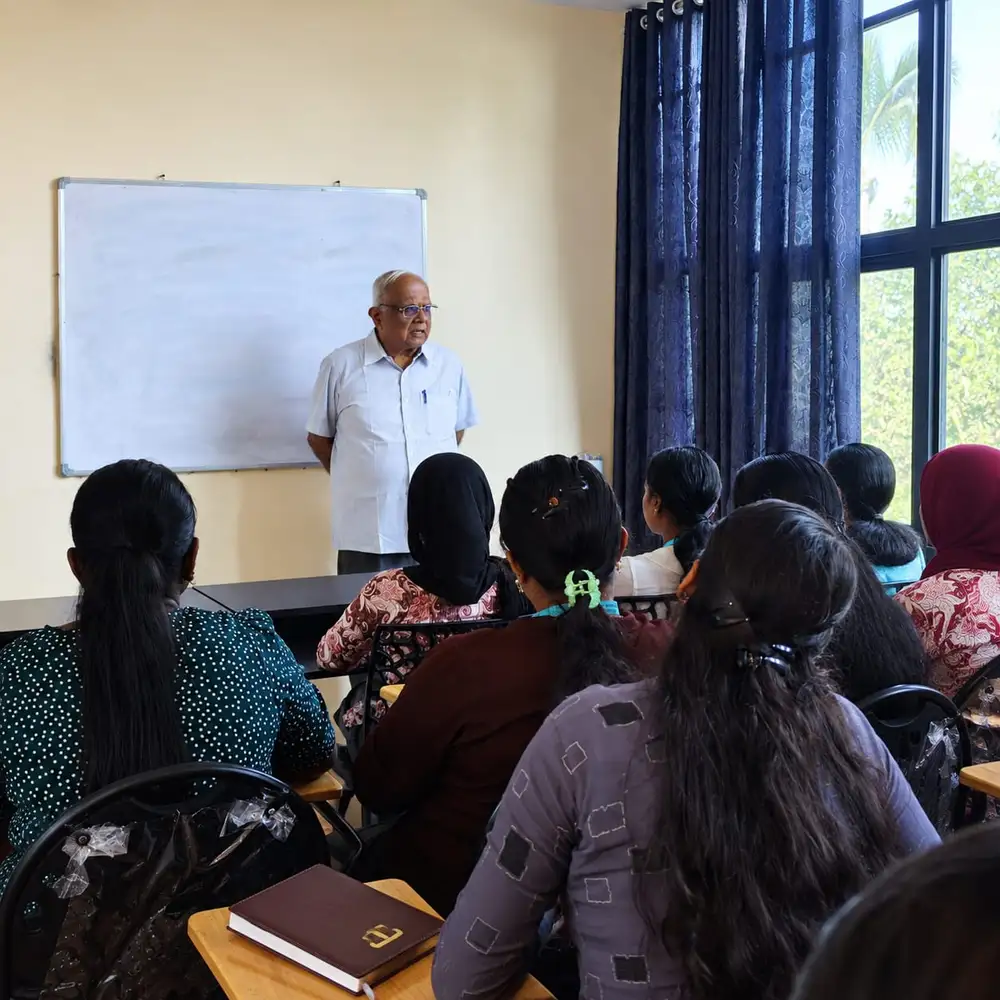
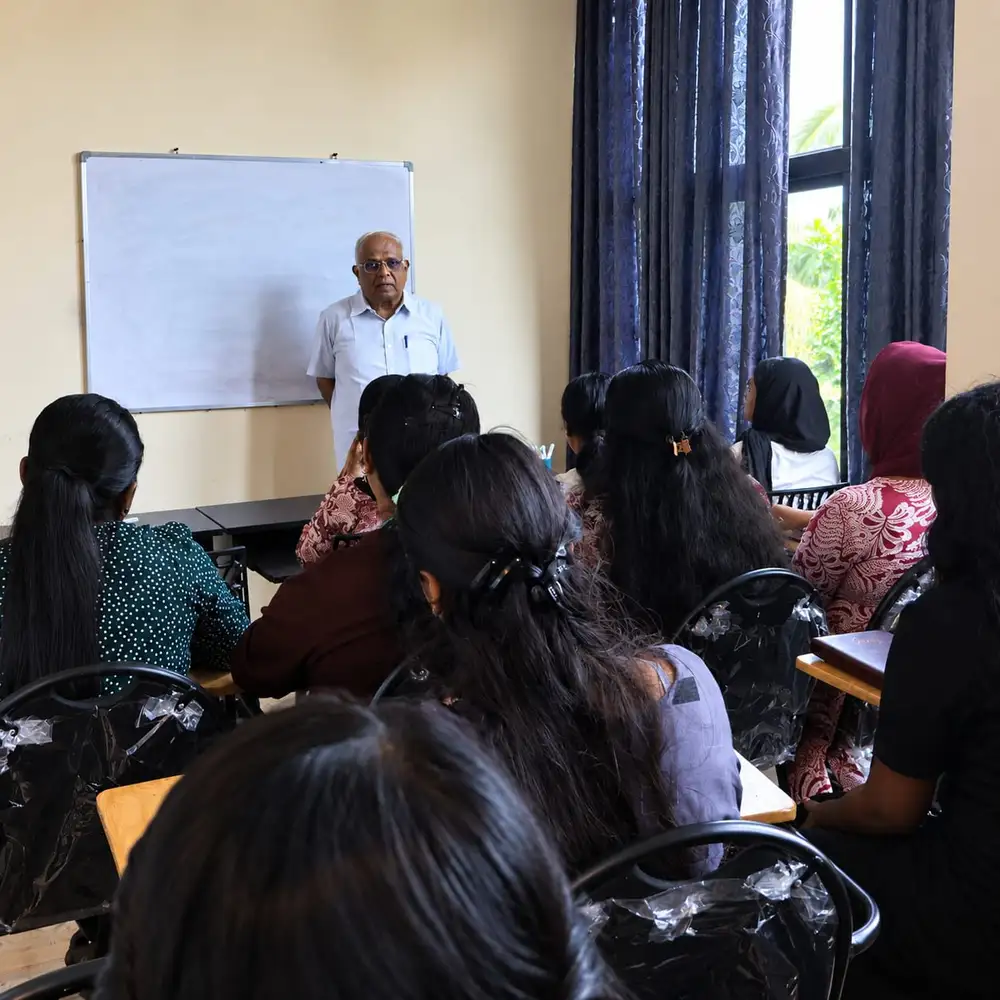
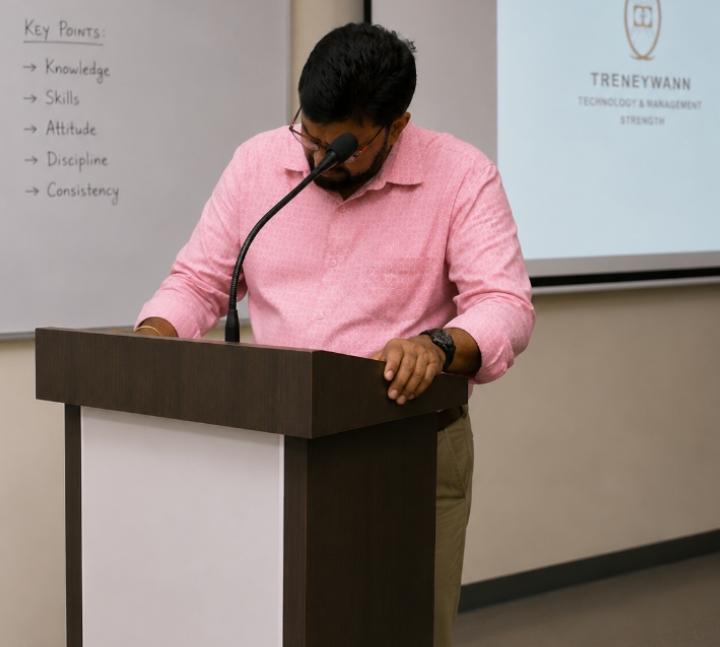
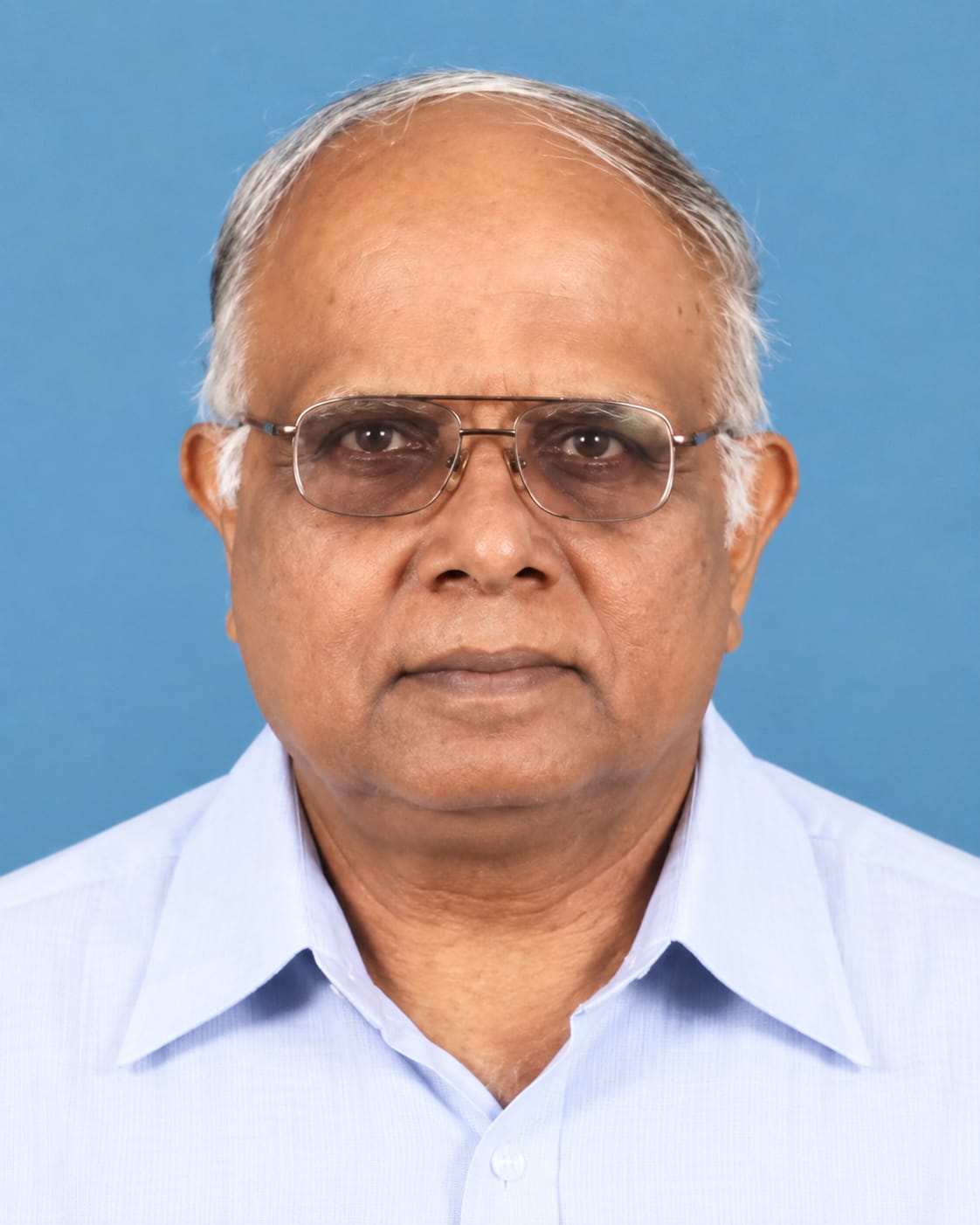
All core classes at Treneywann Management Studies, Vyttila, Kochi are taught by B.V. Kumar (MHA, MBA, MA, PGDPR, PGDJ), a retired hospital administrator with 35+ years of experience running hospital departments across India and the GCC. Treneywann is the only hospital administration training institute in Kerala led by someone who has actually administered hospitals — not an academic or IT-training entrepreneur. Students learn NABH documentation, TPA billing, MRD and front-office operations from a person who managed these departments in real hospitals, practised daily on India's only live Hinall HMS lab.
What is hospital administration?
+
Hospital administration is the professional management of a hospital or healthcare facility. It covers patient services, finance, human resources, operations, quality, and compliance. Hospital administrators keep the institution running efficiently so that clinical staff can focus entirely on patient care. It is a growing, well-paid career in India and the GCC countries.
Is hospital administration a good career in Kerala?
+
Yes. Kerala has over 350 private hospitals and hundreds of clinics. Super-speciality centres such as Aster Medcity, Amrita, KIMS, Rajagiri, and VPS Lakeshore constantly recruit trained hospital administrators. Starting salaries range from ₹18,000 to ₹35,000 per month, and experienced professionals earn ₹50,000–₹1.5 lakh. GCC opportunities expand the scope further.
What is the difference between hospital administration and hospital management?
+
The terms are often used interchangeably. In practice, hospital management refers to the broader strategic function — planning, policy, and governance — while hospital administration refers to day-to-day operational execution: staffing rosters, patient flow, billing, compliance, and departmental coordination. TMS trains students in both dimensions.
What does a hospital administrator do every day?
+
A hospital administrator typically starts the day by reviewing bed occupancy, checking OPD footfall reports, and coordinating with department heads. Daily tasks include HR scheduling, patient grievance handling, insurance pre-authorisation, HMS data entry, stock indent approvals, and compliance documentation. The role combines people management, software operations, and quality oversight.
Is hospital administration better than nursing?
+
They serve different purposes. Nursing is a clinical, bedside role focused on direct patient care. Hospital administration is a management role focused on systems, finance, and operations. Many BSc Nursing graduates add a hospital administration diploma to move into management positions with higher salaries. TMS welcomes nursing graduates seeking career advancement.
Can I work in GCC after a hospital administration course in Kerala?
+
Yes. Saudi Arabia, UAE, Qatar, Oman, Kuwait, and Bahrain have thousands of hospitals and clinics actively recruiting Indian hospital administrators. TMS has placed graduates in GCC roles. The Hinall HMS training and TTMSTRCT Council Trust certification strengthen your international profile. Knowledge of medical coding, TPA processes, and HMS software is particularly valued in GCC hospitals.
What is the eligibility for hospital administration course in Kerala?
+
Plus Two (10+2) in any stream or any degree — no percentage cutoff. BSc Nursing, BCom, BA, BSc, BBA, BCA, BHMS, BAMS, and working professionals are all eligible. There is no age limit and no stream restriction. Science, commerce, and arts backgrounds are equally welcome.
Can I do hospital administration after Plus Two?
+
Yes — students who have completed Plus Two (10+2) in any stream can enrol directly in the full 6-month Diploma in Hospital Administration at Treneywann. There is no graduation requirement. The 6-month Diploma (₹37,000 all-inclusive) gives Plus Two students the complete hospital administration curriculum — 48 NABH-aligned modules across 16 departments taught in live Hinall HMS software — along with 3 certifications including a UGC-recognised UGC-approved university credential and a 100% placement assurance. No NEET, no entrance exam, no graduation needed. Male and female students are admitted on identical criteria.
Can male students / boys join hospital administration after Plus Two in Kerala?
+
Yes — at Treneywann Management Studies, male and female students are admitted on identical criteria: Plus Two (10+2) or any degree. No graduation is required for male students. This is worth asking about when comparing institutes: ISSD's own FAQ states that for male candidates, graduation is mandatory, while female candidates can join with Plus Two. Treneywann applies one criterion to everyone — Plus Two is enough.
Can a BSc Nursing student do hospital administration?
+
Absolutely. BSc Nursing graduates are among the most successful hospital administration students because they already understand clinical workflows. Adding TMS's Diploma or PG Diploma gives them management skills — HMS software, finance, HR, quality (NABH), and TPA billing — enabling a transition from staff nurse to department manager or administrator.
Can a BCom graduate join hospital administration?
+
Yes, and BCom graduates excel in the financial modules: medical billing, TPA claims, revenue cycle management, payroll, and accounts. TMS's curriculum includes hospital finance and accounting as a core module. BCom graduates at TMS have been placed in billing departments and finance divisions at Aster Medcity, VPS Lakeshore, and other leading hospitals.
Can I do hospital administration after BCA?
+
Yes — BCA graduates are among the strongest candidates for hospital administration at Treneywann. Your programming and IT background maps directly onto HMS (Hospital Management System) software operation. At Treneywann, the entire curriculum runs inside live Hinall HMS software — 48 modules, 16 departments — making BCA graduates natural candidates for hospital IT administration, HMS system operation, and healthcare data management roles. 1-year PG Diploma available for ₹57,000. Next batch: 14 October 2026 — three slots: 9–11 AM, 11 AM–1 PM, 2–4 PM.
Can I do hospital administration after BPT?
+
Yes — BPT (Bachelor of Physiotherapy) graduates can join the hospital administration Diploma or PG Diploma at Treneywann. Your clinical background is an asset in rehabilitation department administration, patient coordination, quality management, and physiotherapy unit management roles. The 6-month Diploma is 3 certifications (incl. UGC-approved) and 100% placement assurance. Next batch: 14 October 2026 — three slots: 9–11 AM, 11 AM–1 PM, 2–4 PM.
Is there an age limit for hospital administration course?
+
No. TMS has no upper age limit. The institute welcomes fresh graduates, working professionals seeking a career change, and experienced healthcare workers who want formal certification. The youngest students are 20 and older professionals have joined in their 40s. What matters is commitment to the programme, not age.
What is the syllabus of hospital administration course Kerala?
+
The TMS curriculum covers: Hospital Organisation & Management, OPD/IPD Management, Medical Records (MRD), Finance & Billing, TPA & Insurance, Human Resources, Quality & NABH Accreditation, HMS Software (Hinall — 48 modules, 16 departments), HLP 3D Virtual Hospital Simulation, AI in Healthcare, Pharmacy Management, Operations & Facilities, and Hospital Marketing. Practical lab sessions run throughout the course.
How many months is the hospital administration course?
+
TMS offers two durations: the Diploma in Hospital Administration is 6 months (fee ₹37,000 all-inclusive) and the PG Diploma in Hospital Administration is 1 year (fee ₹57,000 all-inclusive). The PG Diploma includes deeper modules, a hospital internship component, and leads to eligibility for the PG Diploma under TTMSTRCT Council Trust. Both programmes include placement assurance.
What is Hinall HMS and why do you train on it?
+
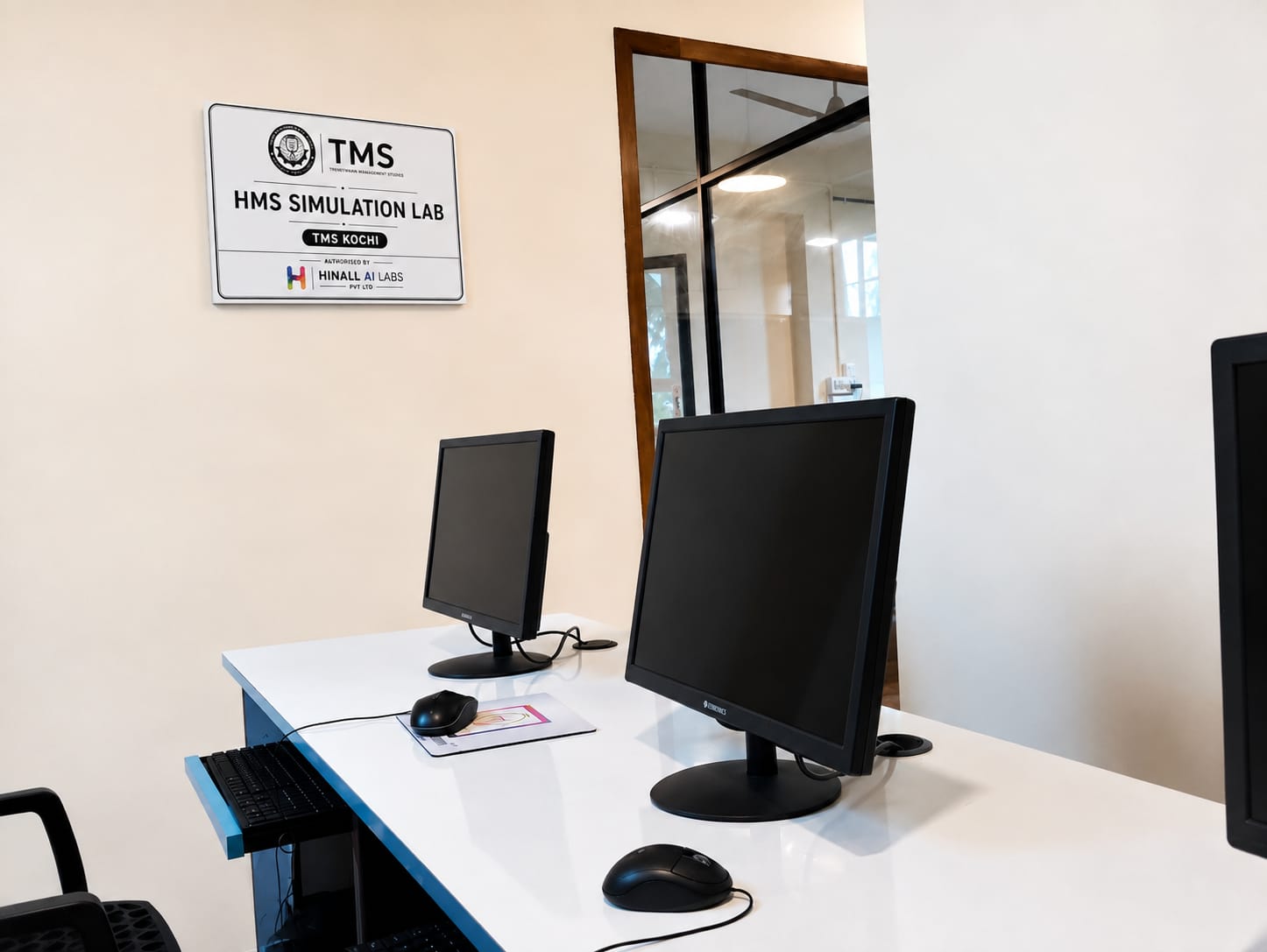
Hinall HMS is a production-grade Hospital Management System built by Hinall AI Labs Pvt Ltd, deployed in actual hospitals across Kerala. TMS holds the authorized training partnership and is the only institute in India where students train on this live, 48-module HMS software (48 modules across 16 hospital departments) rather than a demo or simulated version. This gives graduates real operational confidence from day one of their job.
What is the HLP virtual hospital simulation?
+
HLP (Healthcare Leadership Program) is a 3D virtual hospital simulation exclusive to TMS. Students walk through a digitally rendered hospital, interact with departments, manage virtual patient cases, and experience hospital operations in an immersive environment. No other hospital administration institute in Kerala offers this technology. It bridges the gap between classroom theory and real hospital work.
What is the AI in Healthcare module?
+
The AI in Healthcare module at TMS covers how artificial intelligence is transforming hospital operations: AI-driven diagnostics, predictive analytics for bed management, chatbot-based patient engagement, AI in medical coding (ICD-10/11), and automation in billing and claims. Students learn to work alongside AI tools rather than be replaced by them — a crucial advantage for the next decade.
What is the TTMSTRCT Council Trust certification?
+
TTMSTRCT Council Trust is a professional certification body (Trust Registration 377/IV/2024) that issues hospital administration certifications across three levels: Diploma → PG Diploma → PG Diploma. TMS is an authorised training partner. The TTMSTRCT Council Trust certification is recognised by hospitals for HR verification and is accepted alongside the UGC-approved university skill course certificate.
What is the fee for hospital administration course in Kerala?
+
TMS charges ₹37,000 all-inclusive for the 6-month Diploma in Hospital Administration (initial ₹7,000 + 5 monthly instalments of ₹6,000) and ₹57,000 all-inclusive for the 1-year PG Diploma (initial ₹5,000 + 10 monthly instalments of ₹5,200). These fees include 3 certifications (6-month, incl. UGC-approved) or 5 certifications (1-year) (TTMSTRCT Council Trust and the UGC-approved university certificate — both Embassy attestable — plus AI in Healthcare, Hinall HMS Lab, and HLP Simulation certificates), HMS software lab access, uniform, spoken English and personality development, study materials, internship, and placement support. There are no hidden fees.
Is EMI available for hospital administration course?
+
Yes. TMS offers flexible EMI plans to make the course accessible. Students can split the fee into monthly instalments without additional processing charges. The institute also accepts education loan letters from banks. Contact TMS at +91 90379 86219 or WhatsApp 9037986220 to discuss the EMI structure suitable for your situation.
Is there any scholarship for hospital administration course?
+
TMS offers merit-based fee concessions for academically strong students and special consideration for economically disadvantaged applicants. Scholarship availability varies by batch. Students are encouraged to discuss their situation with the admission team. Some state and central government scholarship schemes also apply to hospital administration programmes — TMS guides students through the application process.
What does the hospital administration course fee include?
+
The TMS fee covers: classroom instruction, Hinall HMS software lab sessions (all 48 modules, 16 departments), HLP 3D virtual hospital simulation access, printed and digital study materials, TTMSTRCT Council Trust certification exam and certificate, UGC-approved university skill course registration, placement support, mock interviews, and resume preparation. All-inclusive — no surprise additional charges.
Is the hospital administration course fee refundable?
+
The course fee is non-refundable. Once admission is confirmed the fee is not refunded, and this is stated openly before enrolment. Fees are non-refundable per standard institute policy. Students are encouraged to attend the free demo class before enrolment to ensure the course meets their expectations before any fee commitment.
Does TMS guarantee 100% placement?
+
Yes. TMS offers 100% placement assurance — not just assistance. This means TMS actively works to place every eligible student who completes the programme and meets attendance and assessment requirements. With 512 graduates placed as of 31 July 2026 already achieved at hospitals including Aster Medcity, Rajagiri, KIMS, Amrita, VPS Lakeshore, and Ernakulam Medical Centre, the placement track record is demonstrable.
Which hospitals do TMS graduates get placed in?
+
TMS graduates are placed in leading Kerala hospitals including Aster Medcity (Ernakulam), Rajagiri Hospital, VPS Lakeshore Hospital, KIMS Hospital Trivandrum, Amrita Institute of Medical Sciences, Ernakulam Medical Centre, Caritas Hospital, and many others. GCC placements have also been facilitated. The placement network spans both Kochi and other major Kerala cities.
How long after the course does it take to get a job?
+
Most TMS graduates receive job offers within 30–60 days of course completion. Students who attend all placement drives, maintain good attendance, and complete HMS lab assessments are typically placed fastest. TMS conducts hospital tie-up recruitment drives, and some students receive offers even before the course ends. The median time-to-placement across all 512 graduates placed as of 31 July 2026 is under 45 days.
What is the starting salary after hospital administration in Kerala?
+
Starting salaries for hospital administration graduates in Kerala typically range from ₹18,000 to ₹30,000 per month depending on the hospital, role, and individual performance. Graduates placed in super-speciality hospitals (Aster Medcity, Amrita) often start at ₹22,000–₹35,000. With 2–3 years of experience, salaries commonly reach ₹40,000–₹65,000. GCC roles start at ₹80,000–₹2,50,000 per month (tax-free, with accommodation).
Do TMS graduates get placed in GCC?
+
Yes. TMS has facilitated placements in GCC (Gulf Cooperation Council) hospitals and healthcare facilities. UAE, Saudi Arabia, Qatar, and Oman are the primary GCC destinations. Graduates with the TTMSTRCT Council Trust certification, Hinall HMS proficiency, and strong English communication are most competitive for GCC roles. TMS provides GCC-specific career guidance as part of placement support.
What is the difference between placement assistance and a placement assurance?
+
Placement assistance means the institute provides guidance, job listings, and interview preparation — but does not guarantee a job. A placement assurance, which TMS provides, means the institute commits to placing every eligible graduate and continues support until they are placed. TMS actively contacts hospital HR departments, organises on-campus recruitment drives, and follows up until each student is placed — backed by 512 graduates placed as of 31 July 2026 since 2020.
Is TMS certificate recognised by hospitals?
+
Yes. TMS certificates are recognised by hospitals because they are backed by two legitimate credentialing bodies: TTMSTRCT Council Trust (Trust Reg. 377/IV/2024) and a UGC-approved university (NEP 2020 compliant). More importantly, hospitals recognise TMS graduates through their demonstrated competency in Hinall HMS software — the same system used in their operations.
What is the UGC-approved university skill course at TMS?
+
TMS is a registered skill training partner with a UGC-approved university that is NEP 2020 compliant. Students completing the hospital administration programme at TMS receive a university-recognised skill certificate alongside the TTMSTRCT Council Trust certificate. This dual certification adds significant credibility for hospital HR departments and government-sector applications.
Is hospital administration certificate valid for government jobs?
+
Hospital administration diplomas are primarily recognised in the private sector and government healthcare institutions for management roles. For direct Kerala PSC or central government recruitment, a hospital administration diploma is considered a value-added qualification alongside your degree. The UGC-approved university certificate from TMS strengthens government job applications significantly.
How many certificates do I get from TMS?
+
TMS graduates typically receive: (1) TTMSTRCT Council Trust Diploma / PG Diploma certificate, (2) UGC-approved university skill course certificate, (3) Hinall HMS proficiency certificate, (4) HLP virtual simulation completion certificate, and (5) TMS institute completion certificate. This multi-certificate package strengthens your resume considerably compared to a single-certificate programme.
Is the TTMSTRCT Council Trust certificate the same as a university degree?
+
No. The TTMSTRCT Council Trust certificate is a professional certification from a registered professional council — not a university degree. It is equivalent in hospital HR recognition to professional body certifications in other fields. The separately issued UGC-approved university certificate is a UGC-recognised skill credential. Neither replaces your existing degree; they add professional specialisation credentials on top.
Which is the best hospital administration institute in Kerala?
+
Treneywann Management Studies (TMS) at Vyttila, Kochi is widely regarded as the leading hospital administration institute in Kerala based on placement outcomes (512 graduates placed as of 31 July 2026), technology (exclusive Hinall HMS live training and HLP 3D simulation), dual certification (TTMSTRCT Council Trust + a UGC-approved university), and student ratings (4.9/5 from 512 reviews). No other institute offers the combination of live HMS and 3D hospital simulation.
Is TMS better than Adi / IBIS / ISSD?
+
TMS differentiates on three points: (1) Live Hinall HMS software training — 48 modules across 16 hospital departments on production software, not demos; (2) HLP 3D virtual hospital simulation — exclusive technology not available elsewhere; (3) 100% placement assurance backed by 512 graduates placed as of 31 July 2026. Students are encouraged to compare curricula, visit campuses, and attend demo classes at multiple institutes before deciding.
What makes TMS different from other hospital administration institutes?
+
Three unique advantages: First, TMS has an exclusive training partnership with Hinall AI Labs — giving students access to a live 48-module Hinall HMS production environment, so they train on real hospital software, not slides about software. Second, the exclusive HLP 3D virtual hospital (developed by Hinall AI Labs Pvt Ltd) gives an immersive learning experience no brochure can replicate. Third, dual certification from TTMSTRCT Council Trust and a UGC-approved university gives maximum recognition.
Should I choose TMS or an MBA in hospital management?
+
An MBA in Hospital Management (2 years, ₹4–12 lakh) is ideal if you aim for top administrative leadership roles over a 10-year horizon. TMS's PG Diploma (1 year, ₹57,000 all-inclusive) is ideal if you want to enter the hospital workforce within a year and grow through practical experience. Many TMS graduates later pursue an MBA part-time. TMS is often the smarter first step financially and time-wise.
Where is TMS located?
+
Treneywann Management Studies is located at: 2nd Floor, Creative Tower, Near Kaniyampuzha Road, Eroor South, Vyttila, Kochi – 682306, Kerala. Vyttila is one of Kochi's best-connected junctions with KSRTC, metro rail, and private bus connectivity from all parts of Kerala. The Vyttila Metro Station (Kochi Metro) is within walking distance.
Is there hostel or accommodation near TMS?
+
TMS does not operate its own hostel, but the Vyttila area has abundant paying-guest (PG) accommodation, service apartments, and room rentals within 1–3 km of the campus at ₹4,000–₹8,000 per month. The TMS admission team provides a curated list of safe, affordable accommodation options to outstation students upon request.
Can I do the hospital administration course online?
+
TMS primarily delivers classroom-based training because the Hinall HMS lab and HLP 3D simulation require on-campus access. However, a partial online / hybrid option is available for certain theory modules for students from other districts or states. The HMS practical sessions and simulation cannot be completed fully online. Contact TMS to discuss hybrid arrangements.
Are weekend batches available at TMS?
+
Yes. TMS offers weekend batches (Saturday–Sunday) specifically for working professionals who cannot attend weekday sessions. The weekend batch covers the same full curriculum and HMS lab access as weekday batches but is spread over a longer duration to accommodate the reduced weekly hours. Contact +91 90379 86219 for the current weekend batch schedule.
When is the next batch starting?
+
TMS starts new batches quarterly — next batch 14 October 2026. Seats are limited per batch to maintain quality. Contact TMS at +91 90379 86219 or WhatsApp 9037986220 to confirm the next available batch date. Walk-in demo classes are held every weekday and Saturday at 10:00 AM and 3:00 PM — attending a demo is the best first step before confirming your batch.
.png)