Hospital Administration After BBA — Your Business Degree Is a Head Start
For BBA graduates in Kerala considering hospital administration at Treneywann Institute of Hospital Administration, Vyttila, Kochi. Reviewed by HOD B.V. Kumar (MHA, MBA, MA, PGDPR, PGDJ — 35+ years across India and the GCC).
Most BBA graduates in Kerala finish three years of management education and then discover something uncomfortable: the degree is respected, but on its own it rarely opens a specific door. Banking wants a certification. Marketing wants experience. The MBA queue is long and expensive. So the question that brings BBA holders to the Treneywann admissions desk is almost always the same one — "I studied business, not healthcare. Will a hospital even look at me?"
Hospitals look at BBA graduates more favourably than almost any other background, for a reason that becomes obvious the moment you stop thinking of a hospital as a clinic and start thinking of it as a business. A 300-bed hospital is a service enterprise with departments, cost centres, inventory, staff rosters, receivables, vendors and regulatory audits. Everything you studied applies. What you are missing is only the healthcare context — a six-month gap, not a three-year one.
Yes, You're Eligible — There Is Nothing Standing in Your Way
The eligibility bar at Treneywann Institute of Hospital Administration is Plus Two in any stream, or any bachelor's degree in any subject. A BBA comfortably exceeds that. There is no entrance exam, no NEET, no minimum percentage and no upper age limit. You do not need Biology at Plus Two. You do not need a science background. You do not need prior hospital experience. If you have your BBA consolidated mark list and degree certificate, you can be admitted to the batch starting 16 November 2026. Full criteria are on the eligibility page.
It is worth saying plainly: hospital administration is a management discipline practised inside a hospital, not a clinical one. The person who runs the OPD counter, settles a TPA claim or prepares an NABH audit file is not treating patients — they are running the system that lets doctors and nurses treat patients. That system is a business system, and you have already studied it.
What Skills From Your BBA Actually Transfer?
Not vaguely — specifically. Here is how a Kerala BBA syllabus maps onto hospital departments:
- Financial Management & Accounting → Hospital billing, tariff structures, package rates, TPA and insurance claim reconciliation, credit-bill follow-up, and revenue cycle management. Hospital finance is where BBA holders start producing value in week one.
- Human Resource Management → Hospital staffing patterns, duty rosters across three shifts, nurse-to-bed ratios, credentialing and privileging files, and the HR documentation NABH assessors ask for during accreditation.
- Operations & Production Management → OPD and IPD patient flow, queue management, turnaround time in radiology and lab, bed management, discharge cycle time. Everything you learnt about bottlenecks and process flow applies directly here.
- Marketing & Services Management → Patient relations, service recovery, referral coordination and health-camp planning.
- Supply Chain & Materials Management → Hospital stores, pharmacy indenting, consumable inventory, expiry tracking and vendor negotiation.
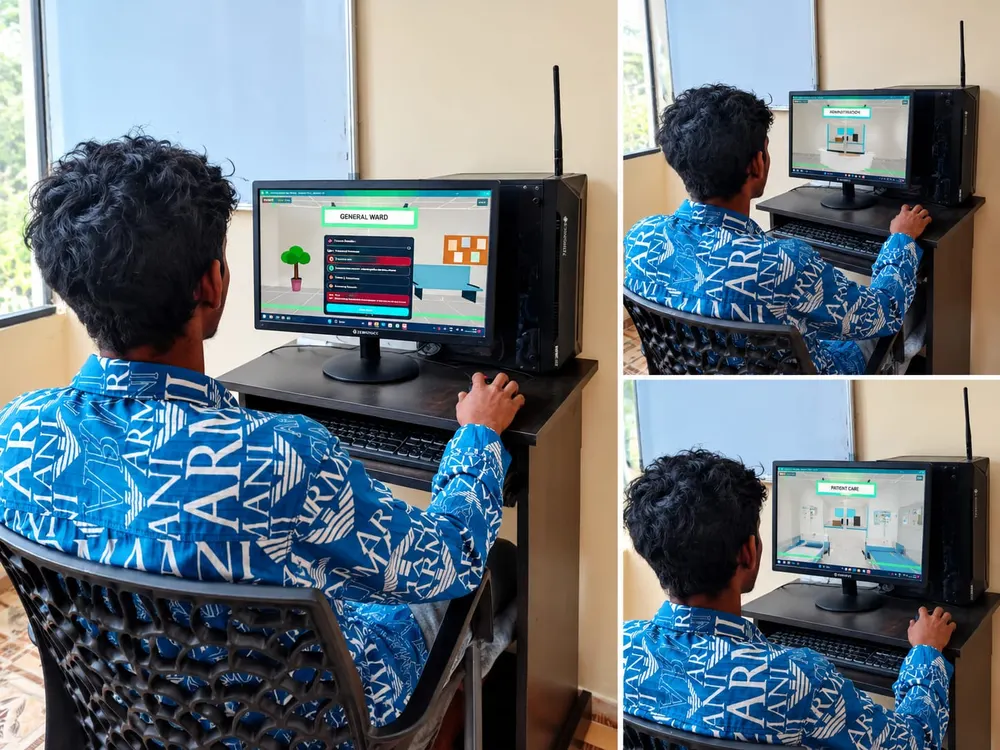
What the BBA does not give you is the healthcare layer: how a Hospital Management System actually runs, how a TPA pre-authorisation is raised and defended, what an MRD department is legally required to retain, and what NABH assessors look for. That is precisely what the Treneywann programme adds, taught on the live Hinall HMS lab — 48 modules across 16 hospital departments, the only live HMS lab in India.
Which Roles Will a BBA Qualify You For?
A BBA graduate with the diploma is not competing for the same opening as a Plus Two entrant. Hospital HR departments grade candidates, and a business degree plus a hospital-specific credential lands you a step higher on the ladder and a step higher on the pay scale.
- Hospital Manager / Operations Executive — departmental coordination, patient flow, daily census and MIS reporting.
- Finance & Billing Administrator — billing desk supervision, package costing, discount authorisation, receivables.
- TPA & Insurance Coordinator — pre-authorisations, claim submission, query resolution, denial management. One of the most consistently advertised hospital vacancies in Kerala.
- Hospital HR Executive — recruitment, rosters, attendance, statutory compliance, NABH HR files.
- Materials & Stores Manager — purchase, inventory control, vendor management.
- Patient Relations Officer (PRO) — patient experience, grievance handling, feedback systems.
Entry salaries for BBA holders in Kerala typically run ₹22,000–₹30,000 per month, above the ₹18,000–₹25,000 general fresher band, because the degree lets you enter at executive rather than assistant grade. GCC hospital roles pay AED 3,000–8,000 per month (roughly ₹70,000–₹1,85,000), and the TTMSTRCT Diploma and UGC-approved university certificate are embassy attestable for exactly that route. Detailed bands are on the Kerala salary guide.
1-Year Course or, for healthcare professionals, doctors, nurses and paramedical holders, the 6 Months Hospital Administration Course — Which Suits a BBA?
For most BBA graduates, the 6 Months Hospital Administration Course at ₹42,000 all-inclusive is the right call. You already hold the management foundation the longer programme spends time building, so the six months are spent almost entirely on the healthcare layer — HMS, billing and TPA, MRD, NABH and front office. You are interview-ready in roughly seven months from enrolment.
Choose the 1-Year Hospital Administration Course at ₹64,000 all-inclusive (awarded as a PG Diploma for degree holders, Advanced Diploma for Plus Two entrants) if either of two things is true: you are targeting the GCC, where a longer credential and a thicker attestation file measurably improve shortlisting; or you want a postgraduate-level qualification on your CV without committing two years and several lakhs to an MBA. Both fees are genuinely all-inclusive — 3 certifications (6-month, incl. UGC-approved) or 5 certifications (1-year) (TTMSTRCT, UGC-approved university certificate, AI in Healthcare, Hinall HMS Proficiency, HLP), uniform, study material, internship and placement support are covered, with zero-interest EMI available.
Your Career Path: Year 1 → Year 5 → Year 10
Year 1. You join as an Operations Executive, Billing Administrator or TPA Coordinator at ₹22,000–₹30,000. The first year is about learning how a hospital actually behaves at 2 a.m. on a busy night, not just on an org chart.
Years 3–5. With a BBA behind you, promotion tends to come faster than for peers without a management degree. Typical titles are Assistant Manager – Operations, Billing Manager, HR Manager or Quality & NABH Coordinator, at ₹40,000–₹60,000 in Kerala. Many graduates move to the GCC at this stage, where the same experience commands several times the Kerala figure.
Year 10. This is the level where the BBA foundation pays off most visibly — Hospital Administrator, Operations Manager or General Manager of a 100–500 bed unit, or a corporate role across a hospital group. Compensation in Kerala at this stage runs well past ₹1,00,000 per month, and the path from here into an executive MBA or MHA while employed is straightforward.
Talk to Us Before the November 16 Batch Fills
Treneywann Institute of Hospital Administration has placed 512 graduates as of 31 July 2026 at Aster Medcity, Rajagiri, VPS Lakeshore, Amrita, KIMS, Medical Trust, Sunrise, Lisie and GCC hospitals, with 100% Placement Assurance. If you want to know exactly where a BBA slots in, ask for the counselling call — it is an advisory conversation, not a sales screen.
Visit Office 49/A, Creative Tower, 2nd Floor, Near Kaniyampuzha Road, Eroor South, Vyttila, Ernakulam, Kerala 682306, call +91 90379 86219, or message +91 90379 86220 on WhatsApp. The next batch begins 16 November 2026 — three slots: 9–11 AM (limited seats), 11 AM–1 PM, 2–4 PM.