.png)






For BSc Nursing, GNM & working nurses · Batch 27 October 2026
Nursing Administration Course in Kerala
We don’t train nurses to leave nursing. We train them to run the ward — staffing, rosters, NABH nursing standards, quality indicators, indenting and documentation, taught by a hospital administrator of 35+ years and by nursing superintendents who have done the job.
The Problem This Course Solves
Nursing is one of the few careers where the promotion has almost nothing to do with the job you trained for. A nurse spends three or four years learning clinical care, works five years becoming genuinely good at it — and is then promoted into a role that is mostly administration: writing the duty roster, defending the staffing ratio to management, chasing the indent for consumables, closing the NABH nursing documentation before an assessment, handling a patient complaint, counselling a junior who is burning out.
Nobody teaches this. Most nurses learn it from whoever held the post before them, badly, under pressure, in their first month as ward in-charge. That is why so many excellent clinical nurses find the step up miserable, and why hospitals so often promote on seniority rather than capability — there is no credential that says a nurse can actually do the administrative half of the role.
This course is that credential, and more usefully, that training. It assumes you already know nursing. It teaches the other half.
Who Can Join
| Qualification | Eligible | Typical reason for joining |
|---|---|---|
| BSc Nursing (including Post-Basic BSc) | Yes | A management credential without committing two years to MSc Nursing |
| GNM | Yes | A route upward that does not require first completing a degree |
| Working nurses (any of the above, in service) | Yes | Already doing the administrative work; want it recognised and done properly |
| ANM | Not eligible | — |
There is no entrance examination and no age limit. Admission is by a counselling call, so you can ask exactly how the course fits your duty roster before you commit anything. If you are not a nurse but want to work in hospital administration, the course you want is the hospital administration course instead.
Fees and Certificates
Most chosen
6-Month Nursing Administration
₹20,000 all-inclusive
2 certificates
- TTMSTRCT Council Trust Diploma certificate
- UGC-approved university Advanced Skill Certification
Fast entry
3-Month Nursing Administration
₹10,000 all-inclusive
2 certificates
- TTMSTRCT Council Trust certificate
- UGC-approved university Skill Certification
Both fees are published, all-inclusive and identical for every student — there is no separate examination fee, certificate fee or material fee added later. The UGC-approved university skill certification is issued under the NEP 2020 skill-course framework and is valid across India; it is the certificate that makes the course readable to an HR desk outside Kerala, and it is attestable for Gulf employment.
Which one to take is genuinely a question of what you need. If you want the qualification recognised for a promotion file or a Gulf application, take the 6-month — the advanced skill certification and the diploma carry more weight, and the syllabus goes considerably deeper on NABH and quality. If you are about to be handed a ward and need to be competent in a hurry, the 3-month covers the working essentials. Full comparison of the two →
What You Learn
The syllabus is built backwards from the actual working day of a ward in-charge, nursing supervisor and nursing superintendent in an Indian corporate hospital.
- Ward and unit management — running a unit as an operational department: bed management, admission and discharge flow, shift handover, escalation, coordination with OT, lab, pharmacy and billing.
- Staffing, rostering and nurse–patient ratios — building a duty roster that survives leave and sickness, calculating staffing requirements, understanding the norms your hospital is assessed against, and making the staffing case to management with numbers rather than complaints.
- NABH nursing standards — the nursing-relevant chapters, what an assessor actually asks a staff nurse, and how to keep a unit assessment-ready as routine rather than as a panic. This draws directly on the institute’s existing NABH teaching: see our CoP and AAC and MoM chapter guides.
- Nursing quality indicators — the indicators a nursing department is measured on (falls, pressure ulcers, medication errors, needle-stick injuries, hand hygiene compliance, catheter and line infections): how they are defined, collected, reported and acted on.
- Documentation and nursing records — nurses’ notes, care plans, consent, incident reporting, handover records; what makes a record defensible and what makes it a liability.
- Supplies, indenting and inventory — consumables, emergency trolley and crash-cart checks, narcotics and high-alert drug custody, CSSD coordination, and the paperwork that governs all of it.
- Infection control in practice — the nursing unit’s role in the hospital infection control programme, biomedical waste segregation, isolation protocol and audit.
- People management for nurses — supervising people you used to work beside, giving difficult feedback, handling grievance and conflict, managing burnout and attrition, and inducting new staff.
- Patient relations and complaint handling — communication with anxious families, breaking difficult news alongside clinicians, de-escalation, and closing a complaint before it becomes an incident.
- Hospital systems for nurses — how a hospital management system handles nursing orders, indents, charge capture and discharge, and why a nursing administrator who understands the software has authority in every operational meeting.
Full module-by-module syllabus →
Who Teaches You
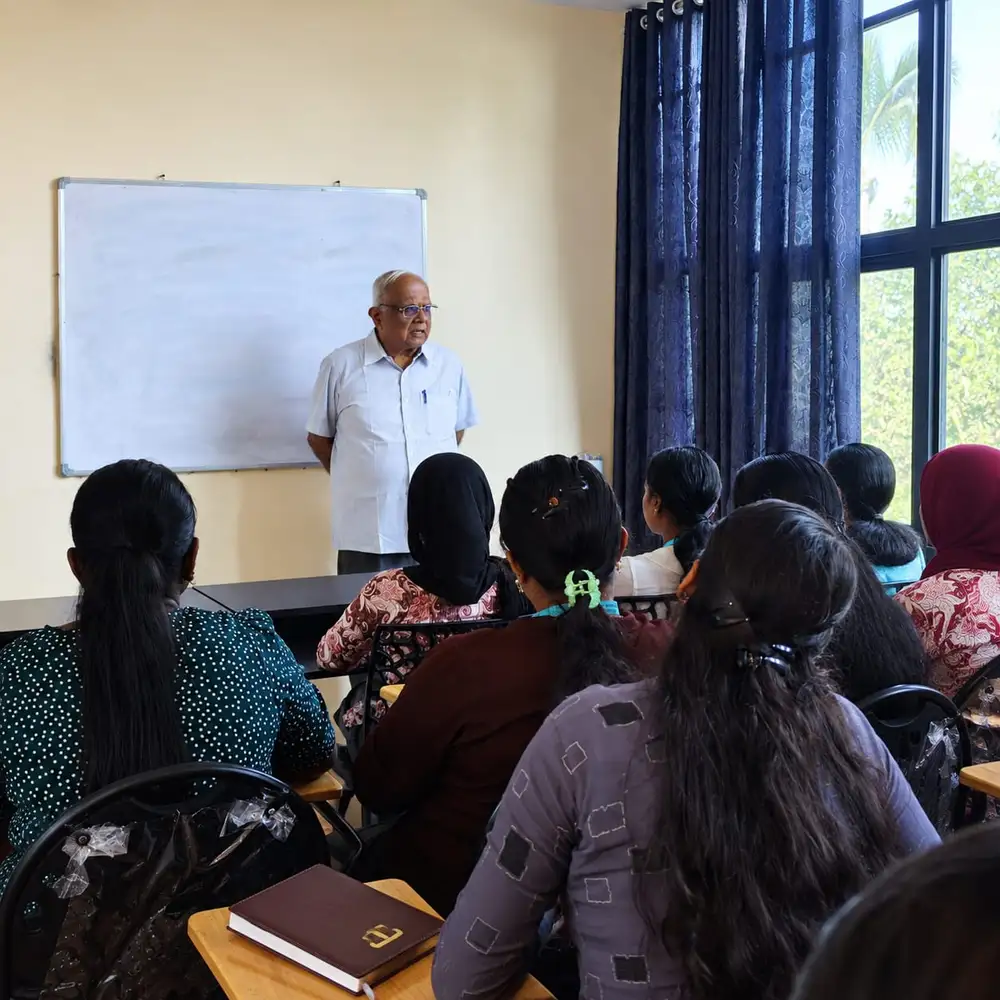
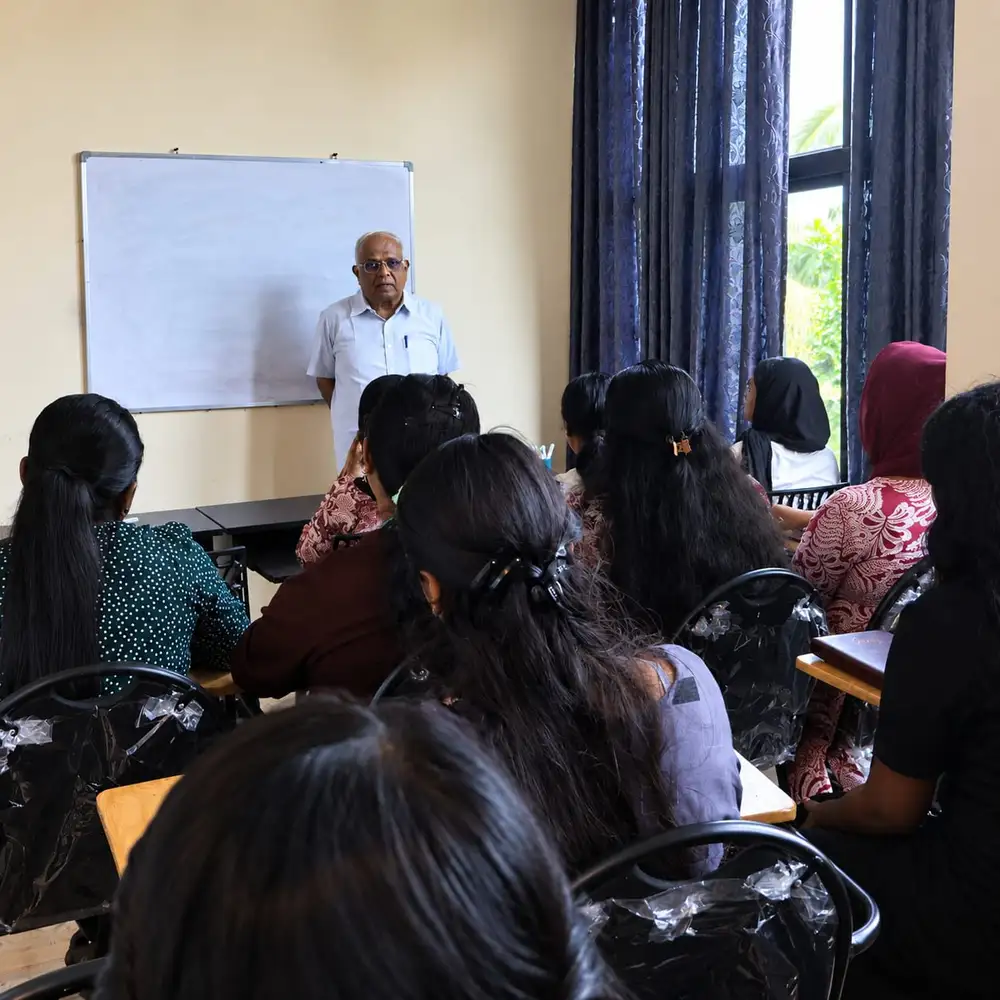
- B.V. Kumar — Head of Department (HOD), Hospital Administration, and Head of Management Studies. A retired hospital administrator with 35+ years running hospital departments across Kerala and the GCC (MHA, MBA, MA, PGDPR, PGDJ). He leads this course. For a nurse, this matters for a specific reason: he is the person who used to sit on the other side of the promotion interview, approve or reject the staffing request, and answer to management for the nursing department’s numbers. He teaches what that side of the table is actually looking for.
- Nursing superintendents — serving and retired nursing superintendents take the ward management, rostering, nursing quality and people-management sessions. They have run the departments you are training to run.
- M. Ramachandran — Senior Guest Lecturer, former Director of the Kerala Media Academy, 35+ years in communication. He takes the patient-relations and complaint-handling sessions.
How It Works Around Your Duty Roster
This course was designed on the assumption that most of the people taking it are already working full shifts, often nights, often with no say in next month’s roster.
- Classes are online, so there is no commute to find time for.
- Practical and case sessions run at weekends at the Vyttila, Kochi campus — 300 m from Vyttila Metro — for students who can attend in person.
- Sessions are recorded. A night duty or an emergency shift does not mean losing a module.
- Assessment is coursework and a final examination, scheduled with working candidates in mind.
Nurses outside Kerala can take the course fully online; see the working nurses’ guide for how the schedule is handled in practice.
What It Is Not — Stated Plainly
This is not MSc Nursing, and it is not an Indian Nursing Council nursing qualification. It does not change your clinical registration, and it does not by itself make anyone a Nursing Superintendent — that is a hospital’s appointment, made on experience as well as qualification.
What it is: a focused administration and management training for nurses, with two certificates including a UGC-approved university skill certification, that prepares you for the administrative half of charge, supervisory and superintendent roles — and gives you something to put in a promotion file. We say this at the top rather than leaving you to discover it, because a course that is vague about what it awards is a course you should not pay for. If MSc Nursing is what you actually want, compare the two honestly here.
Why Learn It Here
Treneywann Management Studies is Kerala’s only healthcare-only institute — every course it runs is a hospital course. Every other institute in Kerala that offers hospital or nursing management also runs four to eighteen unrelated programmes: logistics, accounting, digital marketing, fitness training. That is not a slogan; it is a table you can check against their own websites. The practical consequence for you is that the faculty, the case material and the placement contacts all come from hospitals, because there is nowhere else for them to come from.
Within Kerala, Treneywann offers 100% Placement Assurance, with 512 graduates placed as of 31 July 2026 across its hospital network.
Go Deeper
Detailed guides on the subjects this course covers, and the interview questions for each role it prepares you for — free to read, whether or not you enrol.
The subjects
Interview questions by role
Compared With Other Providers
There are only a handful of real nursing administration courses in India. We put ours beside Medvarsity (₹13,696, 3 months), NHCA (₹45,000, 6 months) and Symbiosis SSODL (₹42,000, 12 months) — including where each of them beats us. See all four compared →
By District in Kerala
Classes are online and weekend practical sessions run at Vyttila, Kochi — so nurses across all 14 districts take the course without changing their duty roster.
Outside Kerala — Live Online
Nurses outside Kerala take the course entirely online, with the same certificates. Note that 100% Placement Assurance applies within Kerala only; outside Kerala the commitment is Placement Assistance.
Frequently Asked Questions
Who is eligible for the nursing administration course?
BSc Nursing graduates, GNM holders and working nurses. ANM is not eligible for this course. There is no entrance examination and no age limit — admission is by a counselling call.
What are the fees?
₹20,000 for the 6-month programme and ₹10,000 for the 3-month programme, all-inclusive and published. No separate examination, certificate or material fees.
What certificates do I receive?
Two in each programme. The 6-month awards the TTMSTRCT Council Trust diploma certificate and a UGC-approved university advanced skill certification. The 3-month awards the TTMSTRCT Council Trust certificate and a UGC-approved university skill certification.
Can I do this while working night shifts?
Yes — that is who the course is built for. Classes are online, practical sessions are at weekends at Vyttila, Kochi, and sessions are recorded so a night duty does not cost you a module.
Is this the same as MSc Nursing?
No. It is not MSc Nursing and not an INC qualification. It is an administration and management course for nurses, covering ward and unit management, staffing, NABH nursing standards, quality indicators and documentation, alongside the clinical registration you already hold.
Is ANM eligible?
No. The course requires BSc Nursing, GNM, or current work as a nurse holding one of those qualifications.
Who teaches it?
B.V. Kumar, Head of Department (HOD), Hospital Administration — a retired hospital administrator with 35+ years in Kerala and GCC hospitals — together with serving and retired nursing superintendents who take the ward management, staffing and nursing quality sessions.
When does the next batch start?
27 October 2026, at Treneywann Management Studies, Vyttila, Kochi. Admissions are open now.
Call +91 90379 86219 or WhatsApp +91 90379 86220 — counselling and admission are completed by phone. Treneywann Management Studies, Vyttila, Kochi.