.png)







OPD (Outpatient Department) administration manages the day-to-day patient flow in hospital outpatient services — including registration, appointment scheduling, consultation coordination, billing, and records management. In Kerala hospitals, OPD administrators use HMS software to handle patient data, insurance pre-authorisations, and NABH documentation. It is typically the entry-level hospital administration role with the highest hiring volume across Kerala's public and private hospitals.
OPD Administration in Kerala Hospitals — What the Job Actually Involves
What is OPD Administration?
The Outpatient Department handles patients who visit a hospital for consultation, diagnosis, or treatment without being formally admitted. OPD is the busiest administrative zone in any hospital — in a mid-size Kerala private hospital, 200 to 600 patients may pass through OPD in a single day.
OPD administration staff are responsible for managing every step of this patient flow. In large multi-specialty hospitals, a dedicated team handles OPD. In smaller hospitals, OPD functions are combined with front office duties.
Core OPD administration responsibilities include:
- Patient registration — new patient (UHID creation) and returning patient (record retrieval)
- UHID (Unique Hospital ID) generation and management in HMS
- Aadhaar and ABHA health ID linking under ABDM mandates
- Appointment scheduling and doctor slot management
- Token and queue management — waiting area coordination
- Consultation billing — fee collection and receipt generation
- Investigation and pharmacy referral processing
- Patient feedback collection (mandatory under NABH)
- End-of-day OPD census report generation
- Insurance pre-authorisation for OPD procedures (select hospitals)
The role requires speed, accuracy, and interpersonal skill in equal measure. An OPD administrator is often the first and last hospital staff member a patient interacts with — the quality of that interaction directly affects patient satisfaction scores, which NABH hospitals track formally.
Step-by-Step OPD Workflow in a Kerala Hospital
New patients: UHID creation in HMS, demographic data entry, Aadhaar/ABHA ID linking. Returning patients: record retrieval using UHID or name search. Insurance card verification for TPA patients.
Token generation for walk-in patients. Pre-booked appointment confirmation. Doctor and department slot management. Waiting area assignment and queue communication.
Coordination with OPD nursing staff for pre-consultation vitals. In some hospitals, the administrator updates the HMS encounter record with vitals data entered by nursing.
Patient directed to consultation room. Doctor opens the HMS encounter, records findings, and generates prescription, investigation orders, and procedure referrals in the system.
Consultation fee, investigation fees, procedure charges generated in HMS. Bill presented to patient. Payment collected (cash, card, UPI) or insurance processed. Receipt printed.
Prescription routed to pharmacy in HMS. Investigation orders sent to lab/radiology. Patient directed to respective departments with referral slips or HMS notifications.
Review consultation date entered in HMS. Appointment card or SMS/WhatsApp reminder issued to patient. Doctor slot blocked in appointment calendar.
Mandatory under NABH. Feedback forms (physical or digital) distributed at exit. Responses recorded and forwarded to quality department. Negative feedback triggers complaint resolution protocol.
HMS generates OPD daily census — total patients, department-wise count, revenue summary, doctor-wise patient load. Report submitted to hospital administration. Used for NABH quality indicator tracking.
HMS Software in OPD — Why Live Practice Matters
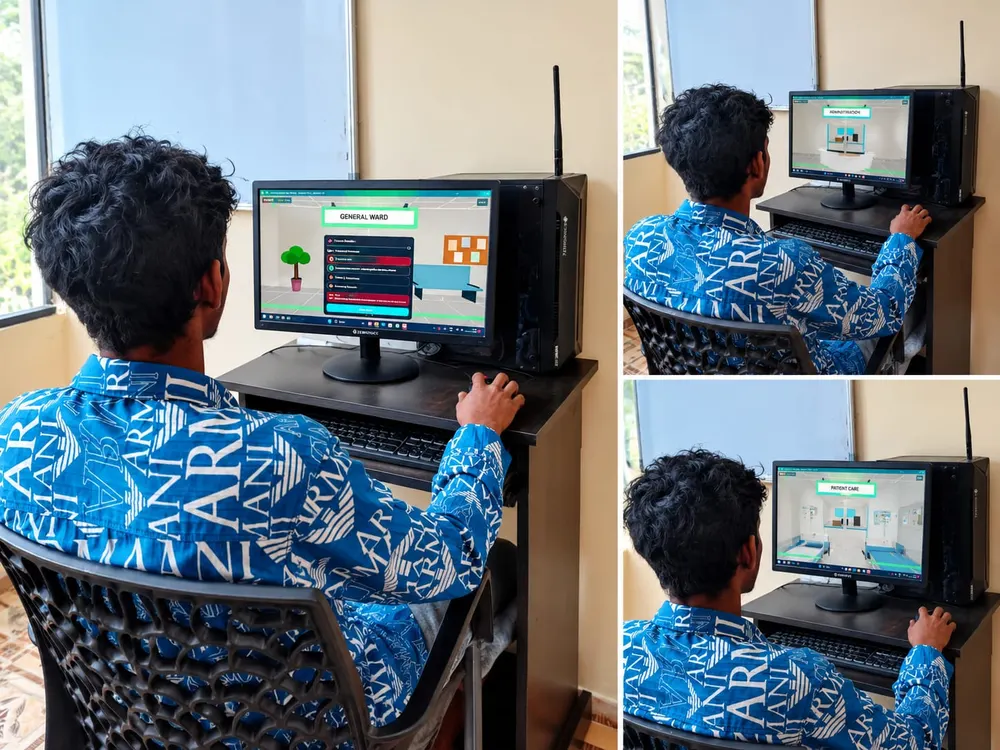
Every step of the OPD workflow above runs through HMS software. In Kerala hospitals, Hinall HMS is one of the most widely deployed platforms. The OPD module of Hinall HMS handles patient search and retrieval, UHID creation, encounter creation, billing, insurance verification, ABHA linking, and daily census reporting — all within a single integrated system.
Kerala hospitals increasingly ask OPD administration candidates: "Have you worked on HMS?" The distinction between a candidate who knows what HMS is and a candidate who can independently process 20 OPD patients per hour on an HMS platform is the difference between a 3-month ramp-up and a Day 1 contribution.
Treneywann's live Hinall HMS lab — India's only live Hinall HMS training lab — gives students this exact operational experience before placement. Students practice UHID creation, encounter management, OPD billing, and report generation on the actual software platform used in Kerala hospitals. This is not a demo or a screenshot walkthrough — students log in and perform real workflows on a live training environment.
See: Hinall HMS Software Training at Vyttila, Kochi and ABDM/ABHA for Hospital Administrators in Kerala.
NABH Requirements in OPD Administration
Kerala has over 400 NABH-accredited hospitals — the highest concentration in India. In NABH hospitals, OPD administration carries formal compliance responsibilities under two key NABH chapters:
Patient Rights & Education (PRE)
Patient rights notice prominently displayed at registration. Patient rights acknowledgement obtained and documented. Patient identity verification at registration.
Access & Continuity of Care (AAC)
Registration process documented with timing. Waiting time monitoring and escalation protocol. Triage mechanism for urgent OPD cases. Continuity of care documentation between OPD and inpatient admission.
Quality Management (QME)
Patient feedback mechanism operational and documented. OPD daily census data maintained and submitted for quality indicator tracking. Complaint resolution records maintained.
Facility Management (FMS)
OPD clinical area safety compliance — fire safety, signage, emergency evacuation routes clearly marked. Administrator ensures OPD space meets NABH facility standards during accreditation survey.
OPD Administration Salary in Kerala
Salaries are higher in NABH-accredited corporate hospital groups and in Kochi and Thiruvananthapuram compared to smaller towns. HMS proficiency and NABH documentation knowledge are the two factors that most consistently produce higher starting salaries for fresh entrants.
Career Path from OPD Executive
Typical timeline to Hospital Administrator level: 5–8 years. Candidates who build HMS, TPA, and NABH competency early in their careers progress faster. Many Treneywann graduates have reached supervisory roles within 2–3 years of placement.
Frequently Asked Questions
Learn OPD Administration with Live HMS Practice
₹42,000 • 6 months • 100% placement assurance for successful students
India's only live Hinall HMS lab • Vyttila, Kochi